inclusionAI Adds Vision to Ling 3.0 Flash
The new Ling-3.0-flash-VL brings a mixture-of-experts vision-language model to inclusionAI's open lineup under a permissive MIT license.
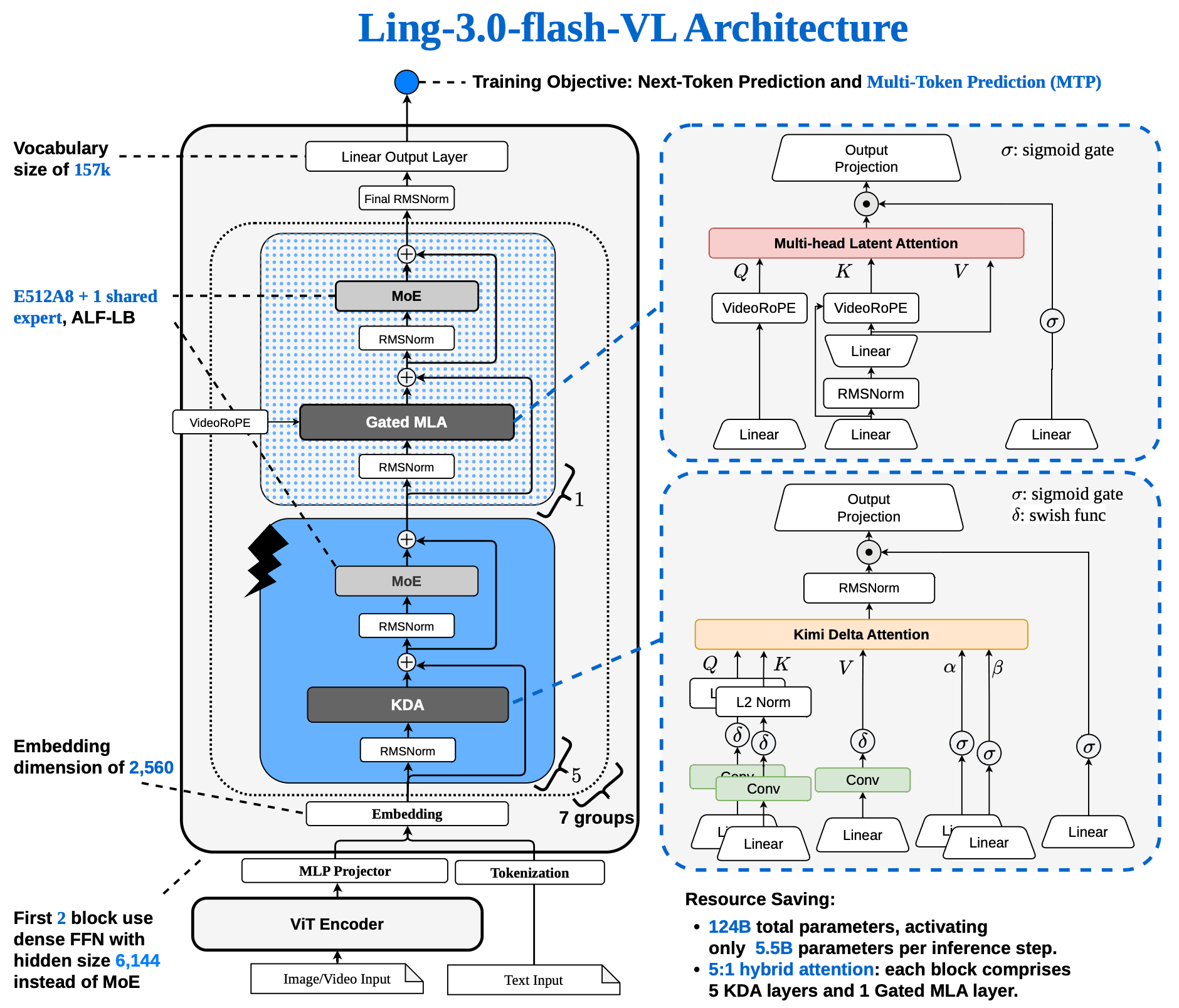
inclusionAI has released Ling-3.0-flash-VL, a vision-language model that extends its Ling 3.0 Flash series into multimodal territory. Built on the bailing_moe_v3_vl architecture, the model pairs image understanding with text generation and ships under a permissive MIT license.
The "flash" branding signals a focus on speed and efficiency, and the model uses a mixture-of-experts (MoE) design — an approach that activates only a fraction of total parameters per token to keep inference costs down while preserving capacity. That makes it a natural fit for teams that want multimodal reasoning without the overhead of a dense frontier model.
Why it matters
MIT licensing is the headline for developers. It allows commercial use, modification, and redistribution with minimal restrictions, lowering the barrier for building products on top of the model. Combined with an efficiency-oriented MoE architecture, that positions Ling-3.0-flash-VL as a practical option for vision-language applications.
A few details worth noting:
- Modalities: vision-language plus text generation
- Architecture: bailing_moe_v3_vl, a mixture-of-experts design
- License: MIT, permissive for commercial and research use
inclusionAI has not published parameter counts or context-length figures in the release record, so buyers will want to check the model card for specifics before deploying. As the first vision-language entry in the Ling 3.0 Flash family, it broadens an already active open-weights lineup.
Sources
- Visit
inclusionAI/Ling-3.0-flash-VL
Hugging Face
More from inclusionAI
All inclusionAI releases →
inclusionAI releases Ling-3.1-flash under MIT license
A new hybrid mixture-of-experts text model arrives on Hugging Face with permissive licensing and a focus on fast inference.
inclusionAI's Ming-Image targets graphic design
A new MIT-licensed text-to-image model leans into legible text rendering and transparent RGBA output for design work.
LLaDA-UI Brings Diffusion Decoding to GUI Agents
inclusionAI's 16.7B MoE vision-language model uses block-wise diffusion to drive graphical interface tasks.
More in Vision-Language
All Vision-Language →
MiniMax Debuts M3.1 Flash, a Multimodal MoE Model
The new release pairs a mixture-of-experts design with agentic, coding, and video-understanding abilities in a single open model.

DeepSeek V4.1-Flash Adds Vision and Reasoning
The new MIT-licensed checkpoint folds image understanding and reasoning into DeepSeek's fast, mixture-of-experts Flash line.
NVIDIA's Nemotron 3.5 Super VL Pairs Vision With MoE Efficiency
The 120B-parameter vision-language model activates just 12B per token and ships in NVIDIA's NVFP4 format for leaner inference.
0 comments
No comments yet. Be the first to weigh in.