OpenBMB Releases MiniCPM-V for On-Device Vision
The new open-source vision-language model is designed for high-resolution image understanding on mobile and edge devices.
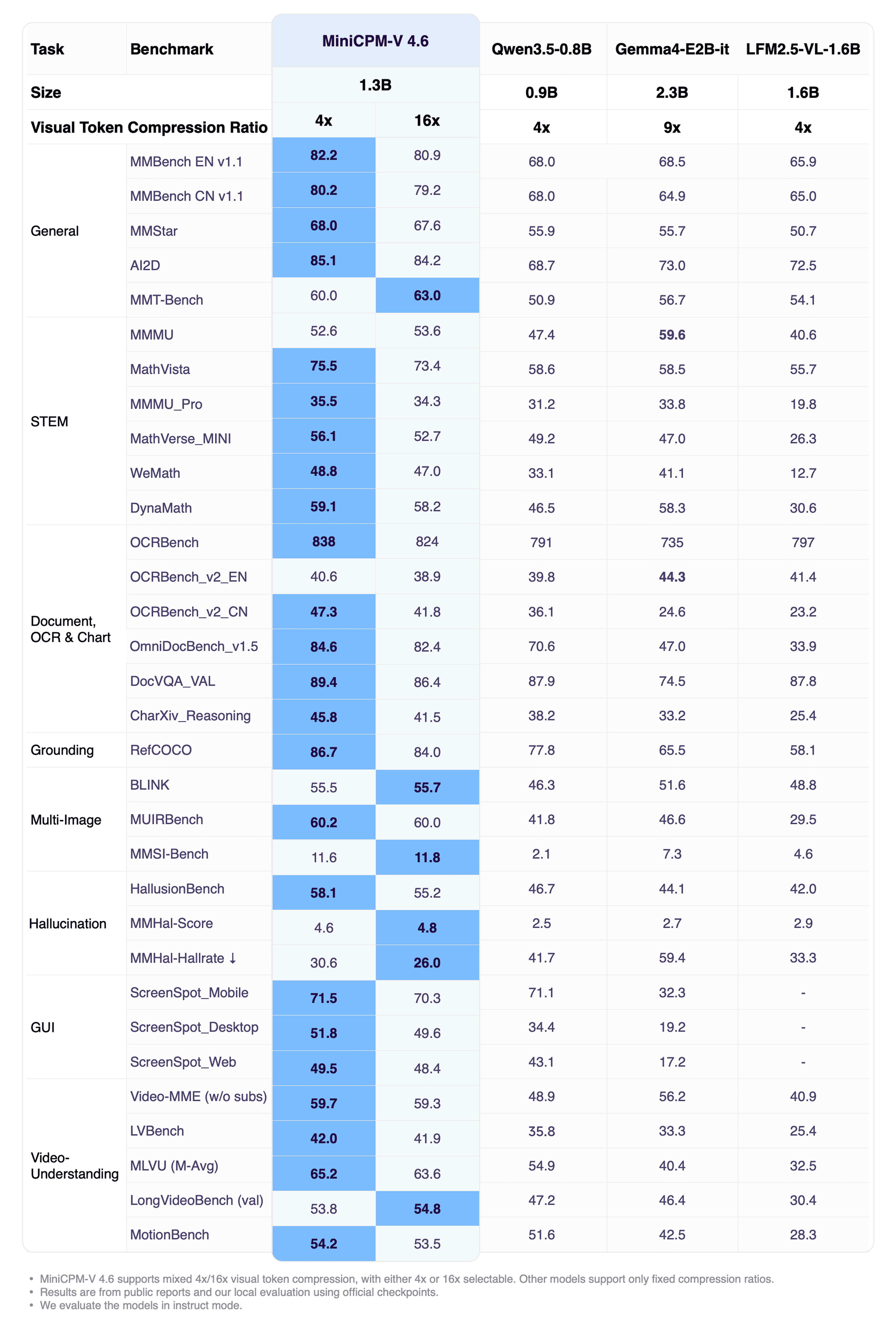
AI research group OpenBMB has released MiniCPM-V-4.6, a lightweight, open-source vision-language model (VLM) explicitly designed for efficient performance on consumer hardware like mobile phones. The model aims to bring powerful multimodal understanding, previously limited to cloud-based services, directly to edge devices.
At its core, MiniCPM-V-4.6 combines the Llama-3-8B-Instruct language model with a SigLIP-400M vision encoder. According to the release details available on its Hugging Face repository, the model was trained on a 10 billion token dataset of high-quality image-text pairs. A key feature is its ability to process images at a high resolution of up to 1848x1848 pixels, which the developers claim gives it exceptional optical character recognition (OCR) capabilities.
Performance and Features
OpenBMB reports that MiniCPM-V-4.6 demonstrates strong general-purpose visual understanding and instruction-following ability. Key highlights include:
- High-Resolution Support: Enables detailed analysis and superior OCR.
- On-Device Focus: Engineered for efficient inference on mobile and terminal devices.
- Open Access: Released under the permissive Apache 2.0 license.
The developers claim the model surpasses several proprietary models, including GPT-4V, in certain open-ended evaluations, highlighting its strength in real-world visual reasoning tasks.
By targeting on-device deployment, MiniCPM-V-4.6 represents a significant step toward making advanced AI more accessible, private, and responsive. Running models locally reduces reliance on network connectivity and lowers latency, opening up new possibilities for real-time multimodal applications on personal devices.
Sources
- Visit
openbmb/MiniCPM-V-4.6
Hugging Face
More in Vision-Language
Agnes-3.0-Flash arrives as a multimodal reasoning model
The new release pairs vision-language understanding with a hybrid-attention design aimed at long-context reasoning.
SenseTime's SenseNova-U1.5 Unifies Vision Tasks
An 8B model drops the usual encoder and VAE in favor of a single native architecture spanning understanding, reasoning, and image generation.
LLaDA-UI Brings Diffusion Decoding to GUI Agents
inclusionAI's 16.7B MoE vision-language model uses block-wise diffusion to drive graphical interface tasks.
0 comments
No comments yet. Be the first to weigh in.