Microsoft's Mage-VL Streams Video Natively
A codec-native multimodal foundation model aims to understand live video and vision-language input in real time.
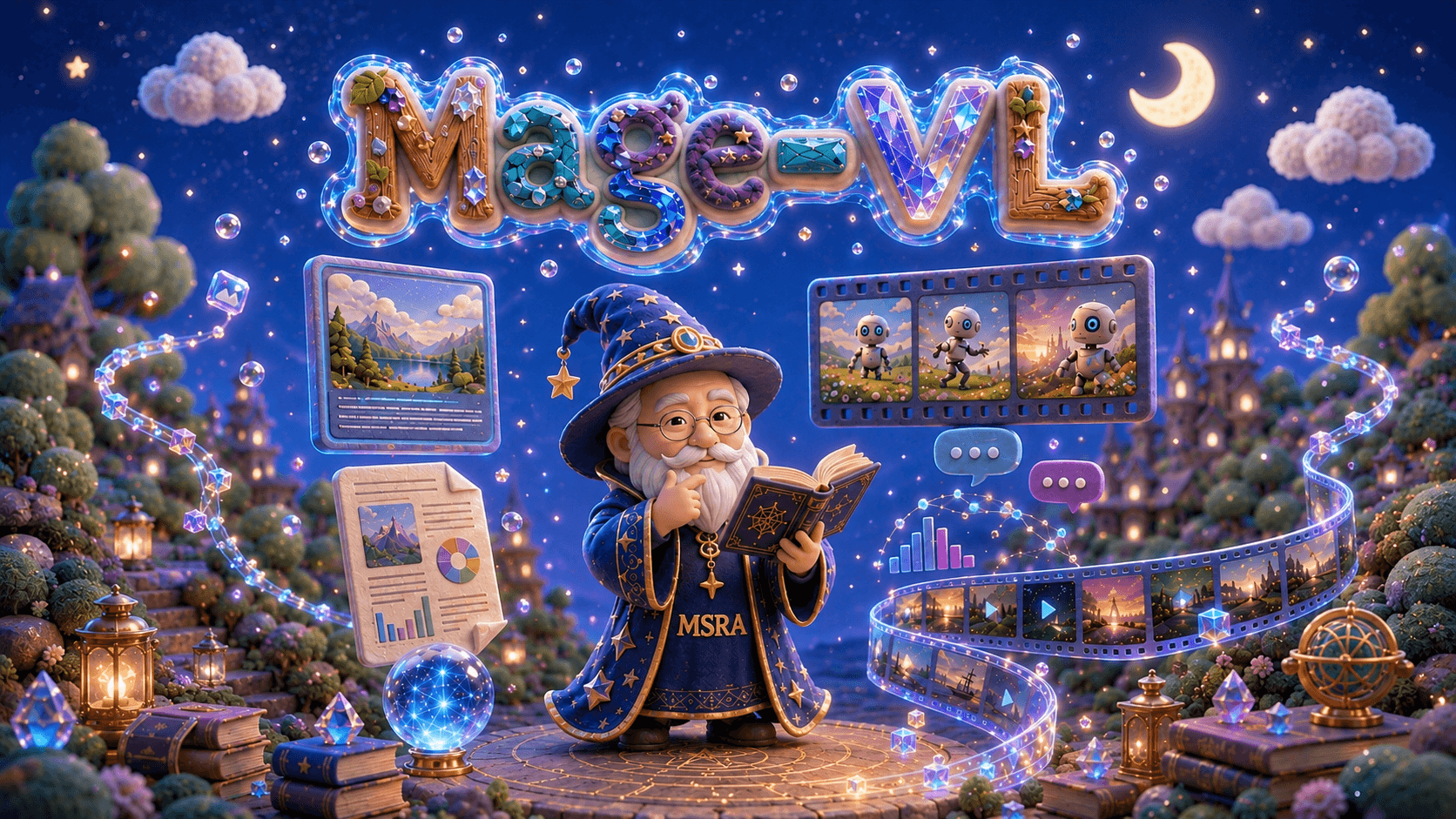
Microsoft has released Mage-VL, a multimodal foundation model designed to process video and vision-language input as it streams rather than after it is fully decoded. The company describes it as a "codec-native" system, meaning it is built to work directly with compressed video formats — a design choice aimed squarely at real-time understanding. Details are available on the model's Hugging Face page.
Why codec-native matters
Most vision-language models expect fully decoded frames, which adds latency and compute overhead when applied to live or long-form video. By operating closer to the encoded stream, Mage-VL is positioned to reduce that overhead and keep pace with continuous input — the kind of workload that matters for live captioning, monitoring, and interactive assistants.
The release covers both general vision-language tasks and streaming video understanding, placing it among a growing class of models that treat video as a first-class modality rather than a sequence of still images.
Key points from the release:
- Primary focus on real-time video and vision-language understanding
- A codec-native architecture intended to cut decoding latency
- Distributed under a custom ("other") license, so teams should review terms before deployment
Microsoft has not published parameter counts, context length, or benchmark figures alongside this initial 1.0 release, so independent evaluation will be needed to gauge how it compares with existing streaming and video-language systems. For now, its arrival signals continued momentum toward models that can keep up with video in motion, not just static frames.
Sources
More in Vision-Language
Agnes-3.0-Flash arrives as a multimodal reasoning model
The new release pairs vision-language understanding with a hybrid-attention design aimed at long-context reasoning.
SenseTime's SenseNova-U1.5 Unifies Vision Tasks
An 8B model drops the usual encoder and VAE in favor of a single native architecture spanning understanding, reasoning, and image generation.
LLaDA-UI Brings Diffusion Decoding to GUI Agents
inclusionAI's 16.7B MoE vision-language model uses block-wise diffusion to drive graphical interface tasks.
0 comments
No comments yet. Be the first to weigh in.