BAAI Releases Emu3.5, an 'Any-to-Any' Multimodal Model
The new open-source model from the Allen Institute for AI unifies text and image understanding and generation into a single architecture.
The Allen Institute for AI (BAAI) has released Emu3.5, a new open-source model that pushes the boundaries of multimodal AI. Available under the permissive Apache 2.0 license, Emu3.5 is designed as a native "any-to-any" system, capable of both understanding and generating interleaved text and images within a single, unified framework.
A Unified Architecture
Unlike systems that chain separate, specialized models for different tasks (e.g., one for captioning, another for image generation), Emu3.5 aims to handle diverse combinations of inputs and outputs natively. The model can accept prompts containing both text and images to generate responses that are also a mix of text and new images. This approach moves beyond simple text-to-image or image-to-text capabilities toward more fluid, conversational interactions across modalities.
This unified design represents a significant step toward more integrated and capable AI systems. By handling complex, multimodal instructions within one architecture, models like Emu3.5 could power more sophisticated applications in creative tools, data analysis, and robotics. Researchers and developers can explore the model and its capabilities on its official Hugging Face repository.
Sources
- Visit
BAAI/Emu3.5
Hugging Face
More in Any-to-Any
StepFun's StepAudio 3 Realtime targets live voice AI
The audio-language foundation model builds a listen-converse-think-act loop aimed at natural, low-latency spoken interaction.
SenseTime's SenseNova-U1.5 Unifies Vision Tasks
An 8B model drops the usual encoder and VAE in favor of a single native architecture spanning understanding, reasoning, and image generation.
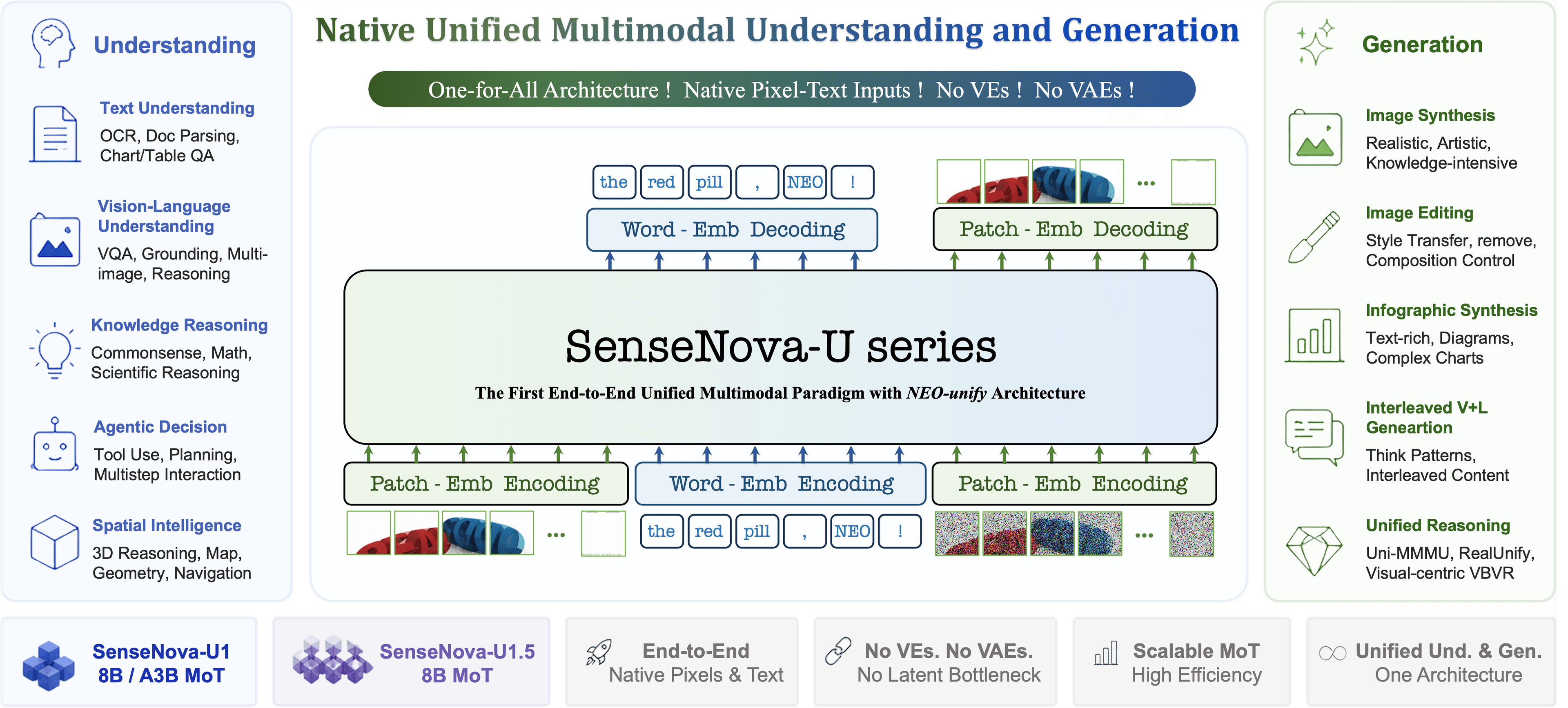
SenseTime Releases SenseNova U1.5 8B Any-to-Any Model
The new 8B multimodal model handles text, images, and image editing within a single native architecture.
0 comments
No comments yet. Be the first to weigh in.