Ornith 1.5 Brings a Lean 35B MoE to Open Weights
The MIT-licensed model activates just 3B parameters per token, borrowing the Qwen3.5 MoE design for text and reasoning tasks.
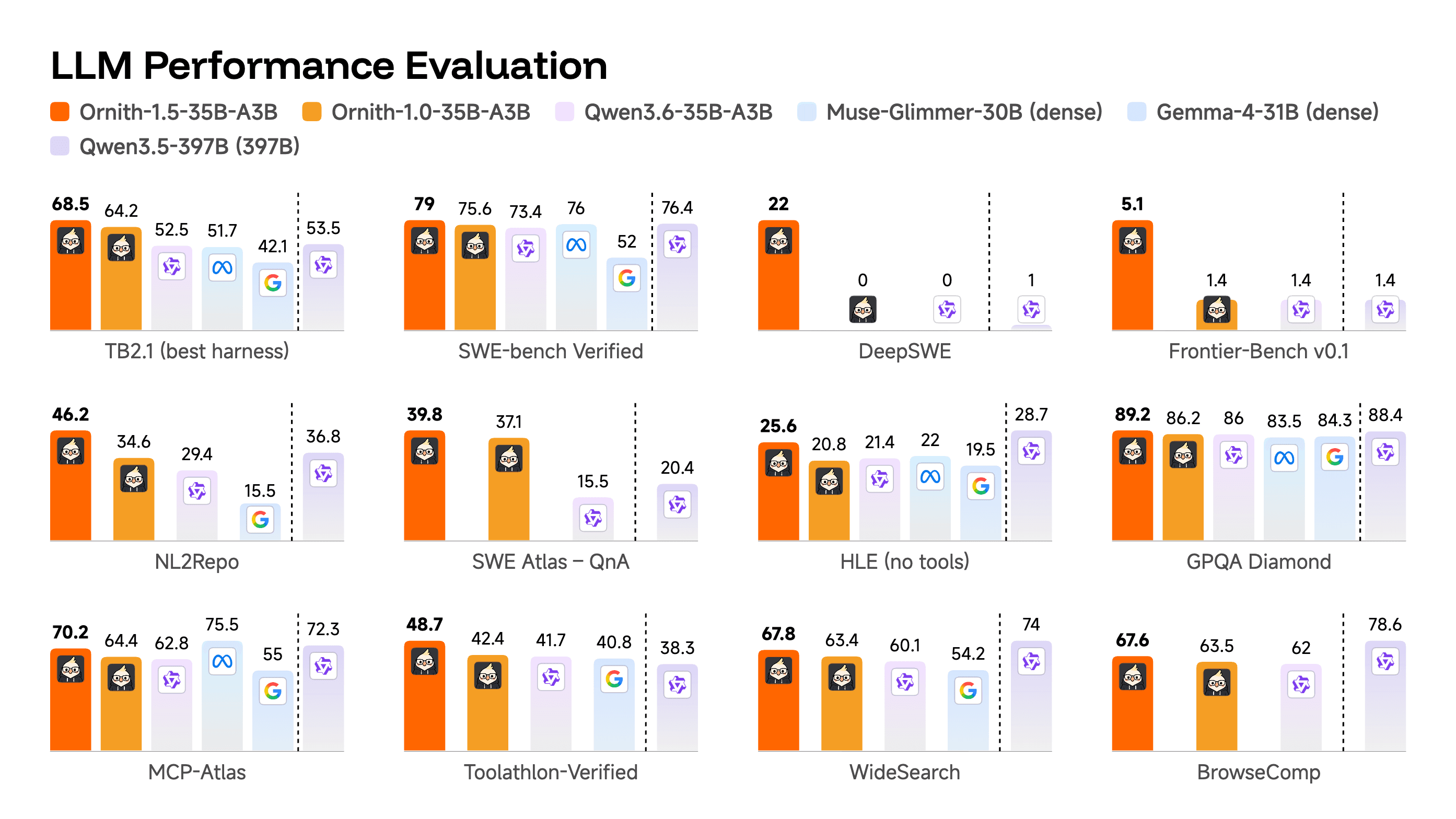
Ornith AI has published Ornith-1.5-35B-A3B, a mixture-of-experts language model that leans on sparsity to keep inference costs down. While the model holds 35 billion parameters in total, only about 3 billion are active for any given token, according to its Hugging Face repository.
The release is built on the Qwen3.5 MoE architecture and targets both general text generation and reasoning. It ships under an MIT license, one of the more permissive options for commercial and research use, which lowers the barrier for developers who want to fine-tune or deploy it without restrictive terms.
Why it matters
The appeal of a 35B/3B-active setup is efficiency: MoE models can offer the knowledge capacity of a larger network while running at the speed and memory footprint closer to a much smaller dense model. That tradeoff has become a popular recipe for teams building on top of Qwen's architecture.
- Total parameters: 35B, with roughly 3B active per token
- Architecture: Qwen3.5 MoE
- License: MIT
- Focus: text generation and reasoning
As a smaller, incremental release, Ornith 1.5 is less about headline benchmarks and more about giving the open-weights community another permissively licensed MoE to experiment with. Details such as context length and evaluation results were not specified in the release record, so prospective users will want to check the repository directly before building against it.
Sources
- Visit
ornith-ai/Ornith-1.5-35B-A3B
Hugging Face
More in Text / LLM
Allen Institute Open-Sources AstaBrief Report Model
The fast report-generation model behind AI2's Asta research assistant is now available under an Apache 2.0 license.

Aleph Alpha releases Kolibri, a sovereign reasoning model
The German AI company's open-weight mixture-of-experts model targets European needs with strong German and English reasoning.
Fastino's GLiNER2.5-Decide targets lean NLP tasks
A sub-1B model bundling entity extraction, intent, sentiment and topic classification arrives on Hugging Face.
0 comments
No comments yet. Be the first to weigh in.