DeepReinforce debuts Ornith-1.0, a 397B MoE model
The flagship of a new open model family arrives under a permissive MIT license, with reasoning among its stated strengths.
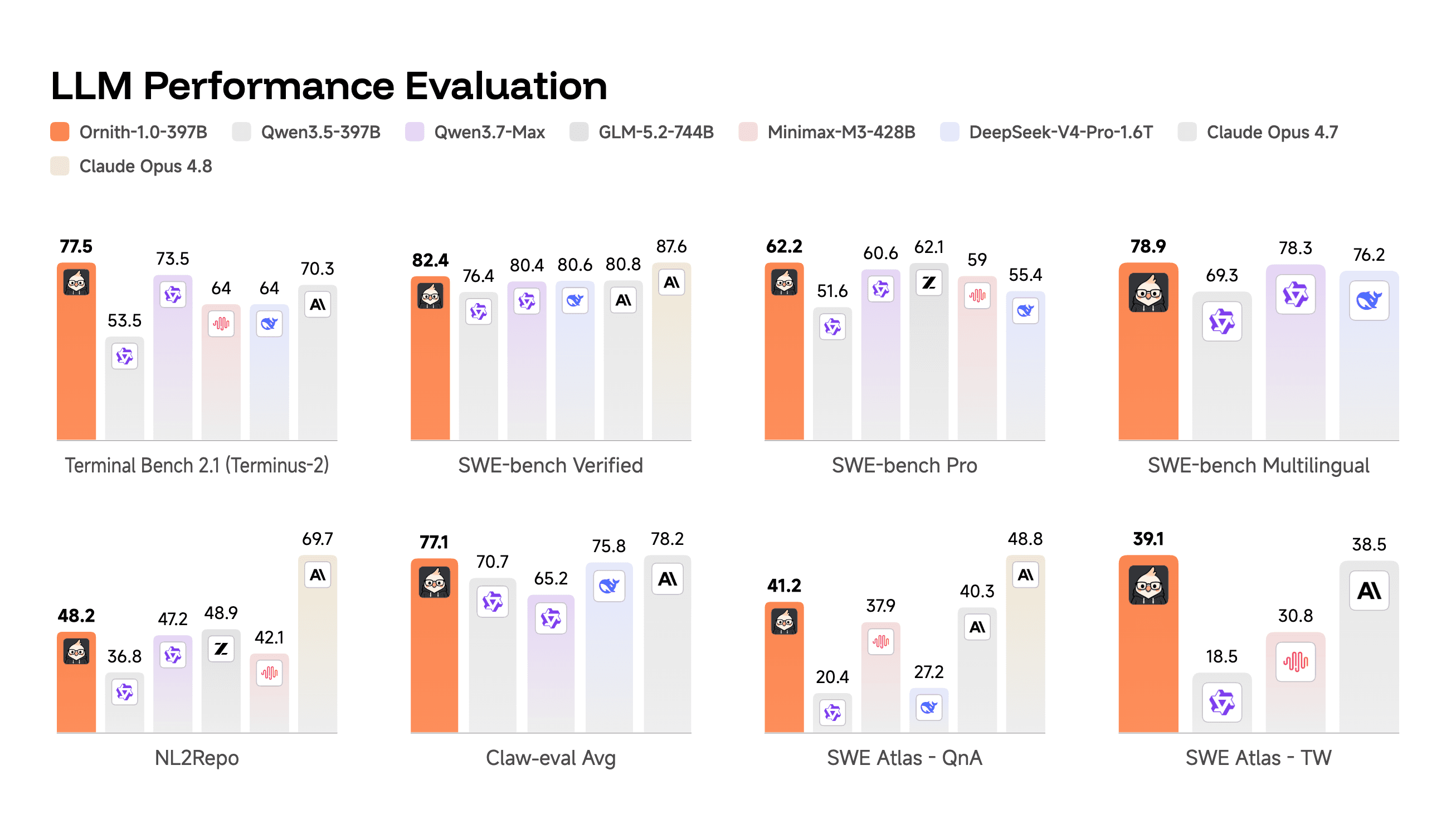
DeepReinforce has introduced Ornith-1.0-397B, the flagship entry in a new family of open language models. The release, published on Hugging Face, is a mixture-of-experts (MoE) system with 397 billion total parameters and is offered under the permissive MIT license.
The model is positioned for both general text generation and reasoning tasks, signaling that DeepReinforce intends Ornith to compete on the harder end of open-weight workloads rather than chat alone. As an MoE design, it routes inputs through a subset of specialized expert networks, an approach that lets a model carry a very large parameter count while keeping the compute used per token comparatively modest.
Why it matters
The choice of an MIT license is the most consequential detail for developers. Unlike the custom community licenses attached to many large open models, MIT places few restrictions on commercial use, redistribution, or fine-tuning. That makes a model of this scale unusually easy to build on.
- A 397B-parameter MoE flagship for a brand-new model family
- MIT licensing, friendly to commercial and derivative work
- Targeted at text generation and reasoning
As a debut release, Ornith-1.0 establishes a baseline for what DeepReinforce can ship. The questions that remain — context length, benchmark performance, and how the smaller siblings in the family will be sized — will determine whether Ornith earns a place alongside the established open MoE models. For now, the weights are available to anyone willing to provision the hardware to run them.
Sources
- Visit
deepreinforce-ai/Ornith-1.0-397B
Hugging Face
More in Text / LLM

Agnes-3.0-Flash arrives as a multimodal reasoning model
The new release pairs vision-language understanding with a hybrid-attention design aimed at long-context reasoning.

InternLM's Atria Dawn Preview Targets Agentic Tasks
A new mixture-of-experts model trained on verified tool interactions arrives as an early preview under an MIT license.
ZGCM-1 arrives as a fully open 7B reasoning model
A compact foundation model targets math reasoning and agentic search with tool use, and its makers are releasing it fully open.
0 comments
No comments yet. Be the first to weigh in.