Ornith-1.0-35B brings a mid-size MoE to agentic coding
An MIT-licensed mixture-of-experts model targets self-scaffolding code tasks without the footprint of a frontier system.
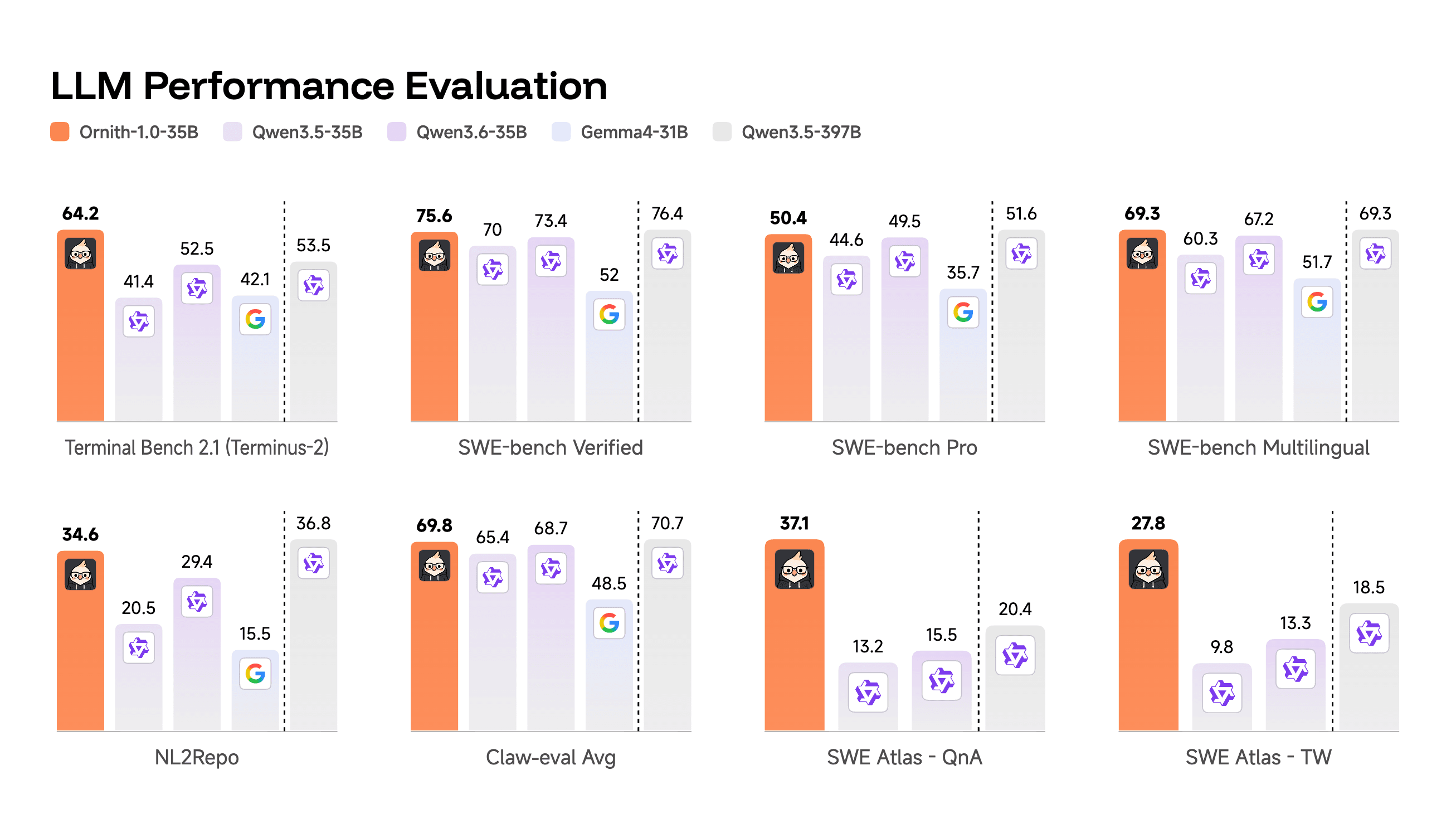
A new entry in the Ornith-1.0 family has landed on Hugging Face: Ornith-1.0-35B, a mixture-of-experts model aimed squarely at agentic coding workloads. Published under the permissive MIT license, it slots in as the mid-size option in a lineup built around what its makers describe as a self-scaffolding approach to code generation.
The headline number is 35 billion parameters in a mixture-of-experts configuration, which means only a fraction of those weights activate on any given token. That design lets a model reach for the reasoning capacity of a larger network while keeping inference costs closer to a smaller dense one — a practical tradeoff for developers who want capable coding assistance without the hardware bill of a frontier system.
Why it matters
Agentic coding — where a model plans, writes, and iterates on code across multiple steps rather than answering a single prompt — has become one of the most competitive corners of open-weights AI. A permissively licensed MoE at this scale is notable for a few reasons:
- The MIT license places minimal restrictions on commercial and derivative use.
- The MoE architecture makes self-hosting more approachable than a comparably capable dense model.
- A mid-size variant gives teams a middle ground between lightweight and heavyweight options in the same family.
As an initial 1.0 release, Ornith-1.0-35B arrives without the extensive benchmark history of established coding models, and the model card is the best source for configuration details and intended use. For teams evaluating open coding assistants, it's worth watching how the self-scaffolding claims hold up against real-world repositories.
Sources
- Visit
deepreinforce-ai/Ornith-1.0-35B
Hugging Face
More in Text / LLM

Agnes-3.0-Flash arrives as a multimodal reasoning model
The new release pairs vision-language understanding with a hybrid-attention design aimed at long-context reasoning.

InternLM's Atria Dawn Preview Targets Agentic Tasks
A new mixture-of-experts model trained on verified tool interactions arrives as an early preview under an MIT license.
ZGCM-1 arrives as a fully open 7B reasoning model
A compact foundation model targets math reasoning and agentic search with tool use, and its makers are releasing it fully open.
0 comments
No comments yet. Be the first to weigh in.