DeepReinforce's Ornith-1.0-9B Targets Agentic Coding
A compact, MIT-licensed 9B model built for autonomous coding tasks arrives on Hugging Face.
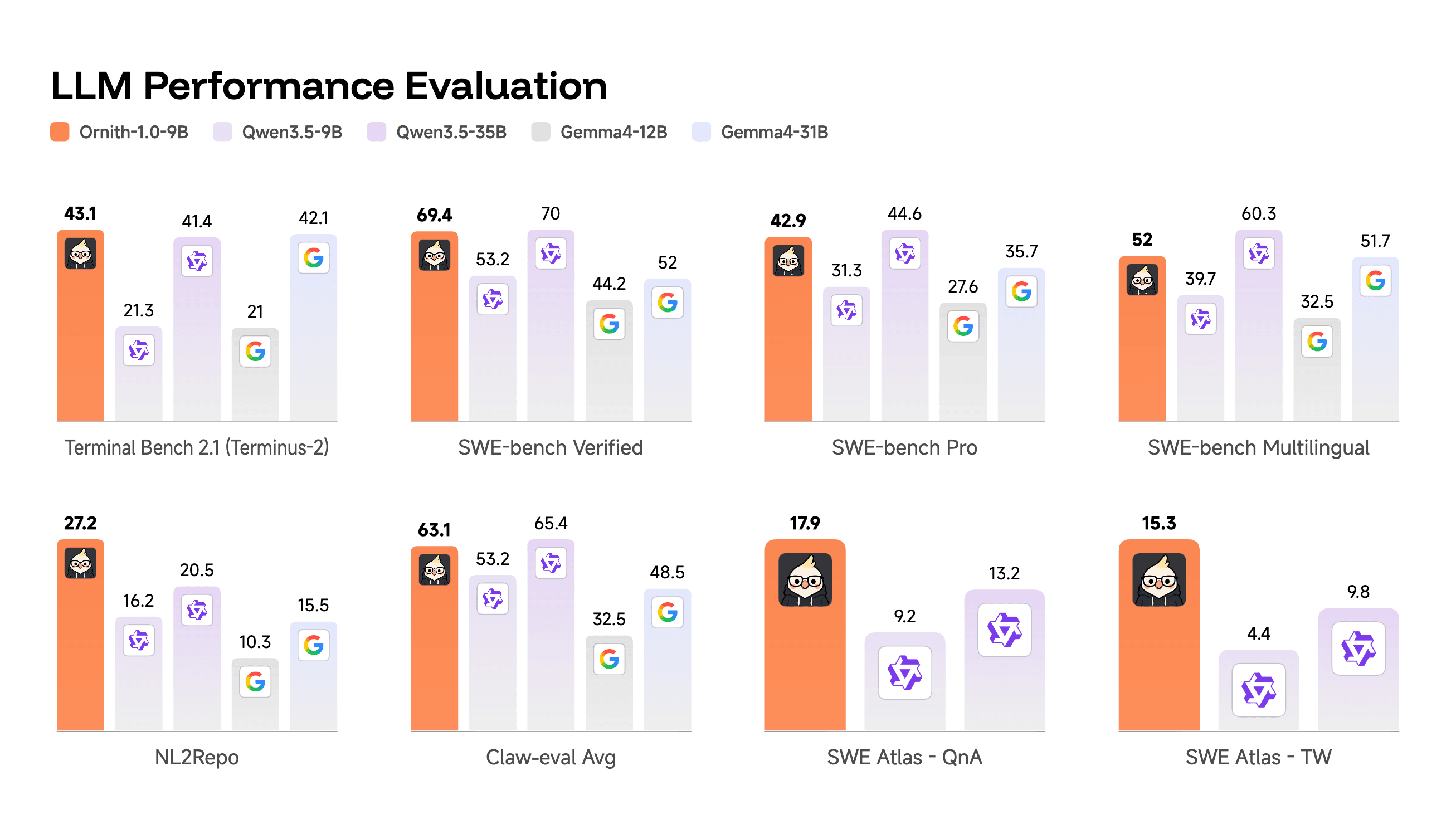
DeepReinforce has released Ornith-1.0-9B, a nine-billion-parameter model aimed squarely at agentic coding workflows. It is a dense (non–mixture-of-experts) model distributed under the permissive MIT license, which allows both commercial and research use with minimal restrictions.
The pitch is size. At 9B parameters, Ornith sits in a sweet spot for teams that want a model small enough to run on modest hardware but capable enough to handle code generation and multi-step, tool-using tasks. That framing puts it in a growing category of compact coding models designed to power autonomous agents rather than one-shot completions.
Why it matters
Agentic coding — where a model plans, writes, executes, and revises code across several steps — has become a defining use case for open-weight models. A few reasons this release is worth noting:
- Permissive licensing: MIT terms make it straightforward to embed in products or fine-tune further.
- Deployability: A 9B footprint is friendlier to local and cost-sensitive deployments than frontier-scale systems.
- Focus: The model is positioned specifically for code and agent tasks rather than as a general-purpose chatbot.
DeepReinforce has not published detailed benchmark figures or a context-length specification in this record, so real-world evaluation will depend on independent testing. For now, the weights and details are live on Hugging Face, and the company outlines the release on its own project page. As the first entry in the Ornith line, version 1.0 sets a baseline the team will presumably build on.
Sources
- Visit
deepreinforce-ai/Ornith-1.0-9B
Hugging Face
More in Text / LLM
Agnes-3.0-Flash arrives as a multimodal reasoning model
The new release pairs vision-language understanding with a hybrid-attention design aimed at long-context reasoning.

InternLM's Atria Dawn Preview Targets Agentic Tasks
A new mixture-of-experts model trained on verified tool interactions arrives as an early preview under an MIT license.
ZGCM-1 arrives as a fully open 7B reasoning model
A compact foundation model targets math reasoning and agentic search with tool use, and its makers are releasing it fully open.
0 comments
No comments yet. Be the first to weigh in.