Deepgrove's Maple Preview bets on ternary-weight MoE
A permissively licensed reasoning model that pairs a mixture-of-experts design with ternary weights, aiming for efficiency.
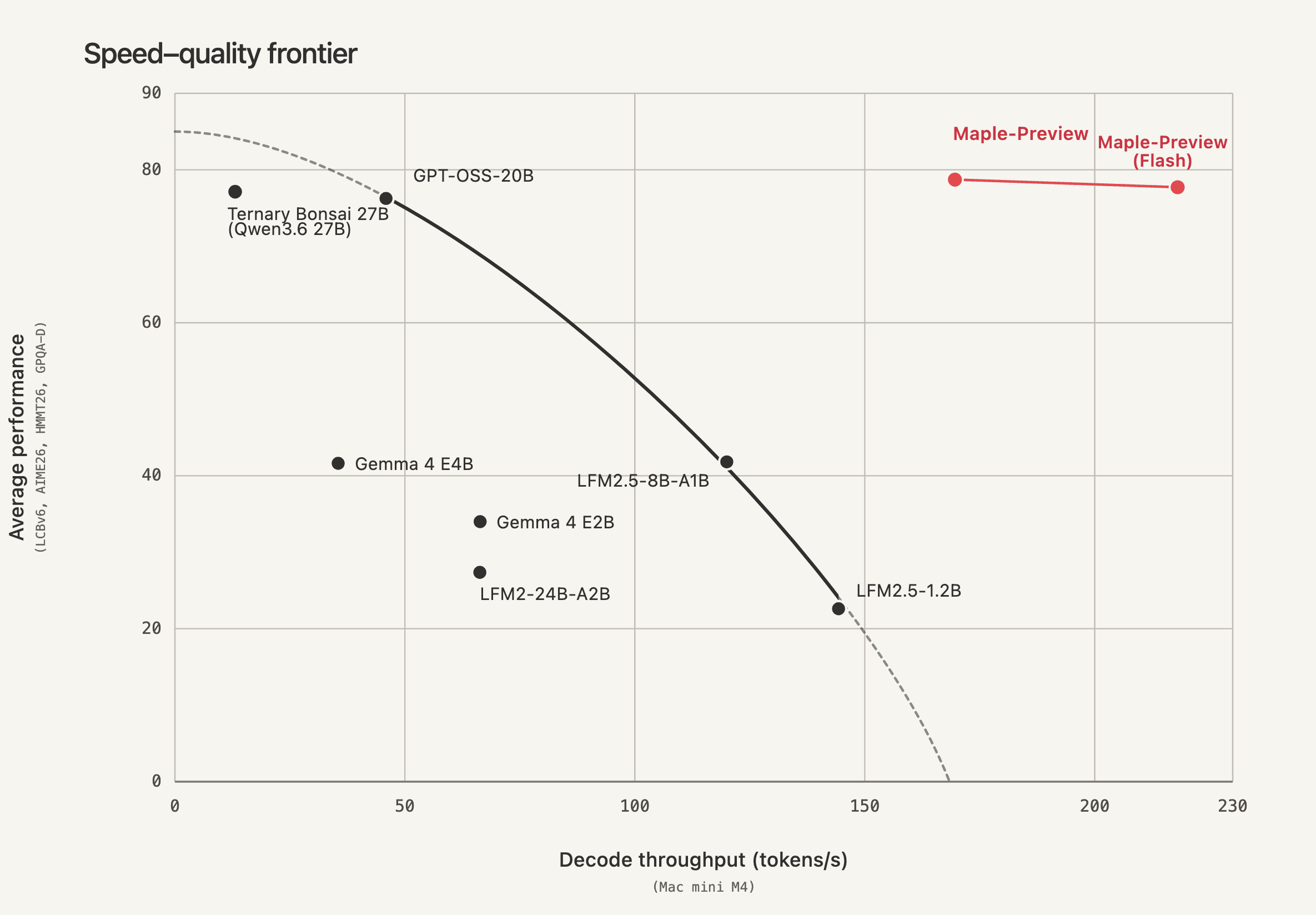
Deepgrove has published Maple Preview, an early look at a reasoning-focused language model that combines two efficiency-minded ideas: a mixture-of-experts (MoE) architecture and ternary weights. The model is available now on Hugging Face under a permissive MIT license.
The design choices are the headline here. MoE models route each token through a subset of specialized "expert" networks rather than activating the full parameter count, which can lower the compute cost of inference. Ternary weights push in a similar direction by constraining values to three states, a quantization approach that can shrink memory footprint substantially compared with standard floating-point weights.
Why it matters
Pairing ternary weights with an MoE layout is an aggressive efficiency play, and reasoning models are a demanding place to try it — they typically lean on longer generations and more compute per query. If the approach holds up, it points toward capable reasoning on tighter hardware budgets.
A few caveats come with the "preview" label:
- Parameter count and context length are not specified in the release record.
- No benchmark results accompany this listing, so quality claims remain to be validated.
- The MIT license keeps the door open for both research and commercial experimentation.
For now, Maple Preview is best read as a signal of direction from Deepgrove rather than a finished product. Teams interested in low-footprint reasoning models will want to test it directly against their own workloads before drawing conclusions.
Sources
- Visit
deepgrove/maple-preview
Hugging Face
More in Reasoning

Agnes-3.0-Flash arrives as a multimodal reasoning model
The new release pairs vision-language understanding with a hybrid-attention design aimed at long-context reasoning.

InternLM's Atria Dawn Preview Targets Agentic Tasks
A new mixture-of-experts model trained on verified tool interactions arrives as an early preview under an MIT license.
ZGCM-1 arrives as a fully open 7B reasoning model
A compact foundation model targets math reasoning and agentic search with tool use, and its makers are releasing it fully open.
0 comments
No comments yet. Be the first to weigh in.