NVIDIA's Nemotron 3.5 Lightning trims MoE for speed
A 30-billion-parameter mixture-of-experts model activates just 3 billion parameters per token, using a hybrid Mamba design to keep inference fast.
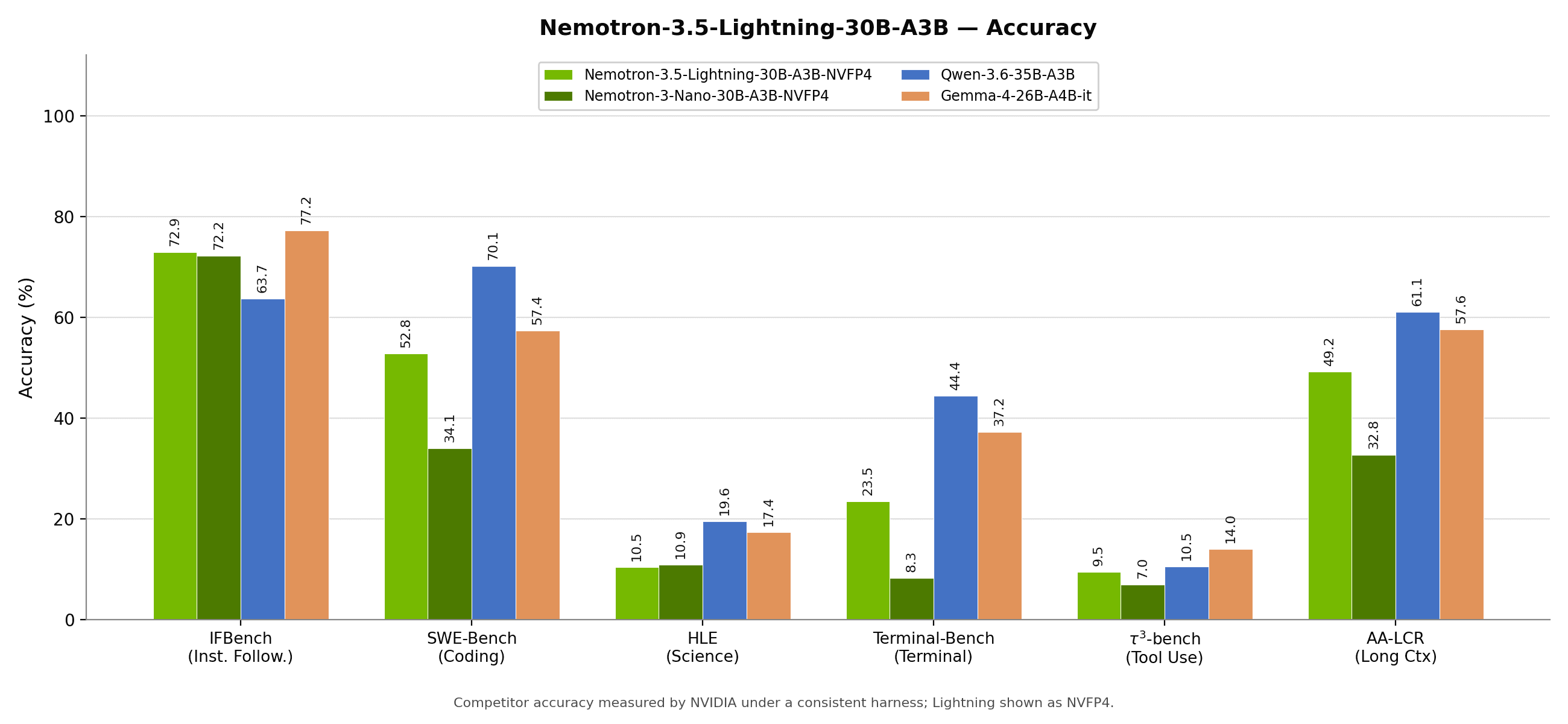
NVIDIA has published Nemotron-3.5-Lightning-30B-A3B, a new open-weights language model that leans on a mixture-of-experts (MoE) design to balance capability against inference cost. The model carries 30 billion total parameters but activates only about 3 billion per token, a ratio that lets it punch above the compute budget of a dense model its size. It is available now on Hugging Face.
The "Lightning" branding points to the model's focus on throughput. Alongside the sparse MoE routing, NVIDIA uses a hybrid Mamba architecture, blending state-space layers with attention to reduce the quadratic cost that traditional transformers pay on long sequences. The result is a model built for faster generation without discarding reasoning ability, which is listed among its core modalities.
Why it matters
Efficiency-first releases are becoming NVIDIA's signature in the open model space, and this one packages several of those ideas together:
- A 30B/3B-active MoE that keeps per-token compute low
- A hybrid Mamba backbone for cheaper long-context handling
- NVFP4 quantization, tuned for NVIDIA's own hardware, to shrink the memory footprint
- Multilingual coverage rather than English-only training
The NVFP4 format is the notable detail here. As a 4-bit floating-point scheme aligned with NVIDIA's latest accelerators, it signals that the company is optimizing not just for accuracy benchmarks but for how these models actually run on its chips. For teams weighing self-hosted reasoning models, that combination of sparse activation and aggressive quantization is the pitch.
NVIDIA has not published a context length for this variant, and the model ships under a custom license rather than a standard open-source one, so prospective users should review the terms before building on it.
Sources
- Visit
nvidia/NVIDIA-Nemotron-3.5-Lightning-30B-A3B-NVFP4
Hugging Face
More in Text / LLM
Allen Institute Open-Sources AstaBrief Report Model
The fast report-generation model behind AI2's Asta research assistant is now available under an Apache 2.0 license.

Aleph Alpha releases Kolibri, a sovereign reasoning model
The German AI company's open-weight mixture-of-experts model targets European needs with strong German and English reasoning.
Fastino's GLiNER2.5-Decide targets lean NLP tasks
A sub-1B model bundling entity extraction, intent, sentiment and topic classification arrives on Hugging Face.
0 comments
No comments yet. Be the first to weigh in.