Datalab Releases Chandra, a New OCR Vision Model
The new vision-language model from Datalab is fine-tuned from Qwen2-VL to specialize in extracting text and structure from complex documents.
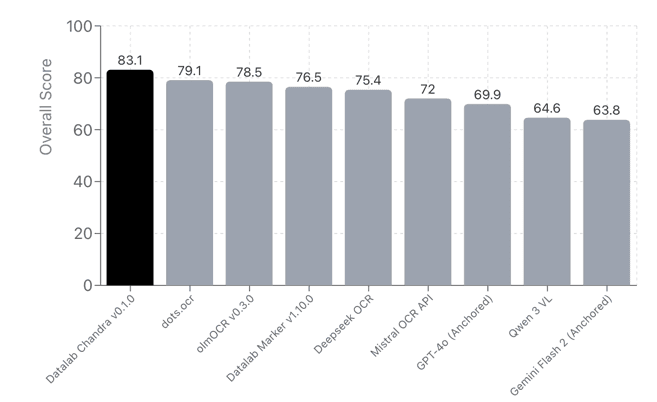
Datalab has introduced Chandra, a new open-source model designed to tackle the complex challenge of optical character recognition (OCR) and document understanding. As a vision-language model (VLM), Chandra goes beyond simple text extraction, aiming to interpret the layout and structure of documents like forms, receipts, and invoices.
The model is a specialized fine-tune of Alibaba's powerful Qwen2-VL-7B, giving it a strong foundation in both visual perception and language comprehension. Datalab has released Chandra under an OpenRAIL license, which permits a wide range of uses while including certain restrictions to encourage responsible deployment of the technology.
While traditional OCR tools are effective at converting clean, printed text into digital formats, they often falter with varied layouts, tables, or handwritten content. By leveraging a VLM architecture, Chandra can analyze a document holistically, understanding the relationship between different visual elements and the text they contain. This capability is key for automating data entry and digitizing complex archives more accurately.
Key Applications
- Extracting structured data from invoices and receipts.
- Parsing complex tables and forms.
- Digitizing handwritten notes and annotations.
- Analyzing documents with multi-column layouts.
Chandra represents a focused application of large vision models to a persistent business problem. For developers working on document processing pipelines, it offers a powerful new tool for improving accuracy and automation. The model and further documentation are available on the Hugging Face Hub.
Sources
- Visit
datalab-to/chandra
Hugging Face
More in Vision-Language
Agnes-3.0-Flash arrives as a multimodal reasoning model
The new release pairs vision-language understanding with a hybrid-attention design aimed at long-context reasoning.
SenseTime's SenseNova-U1.5 Unifies Vision Tasks
An 8B model drops the usual encoder and VAE in favor of a single native architecture spanning understanding, reasoning, and image generation.
LLaDA-UI Brings Diffusion Decoding to GUI Agents
inclusionAI's 16.7B MoE vision-language model uses block-wise diffusion to drive graphical interface tasks.
0 comments
No comments yet. Be the first to weigh in.