LIFT: A Qwen3.5-Based VLM for PDF-to-JSON Extraction
Datalab's new open vision-language model targets structured data extraction from documents, turning messy PDFs into clean JSON.
Datalab has released LIFT, a vision-language model aimed squarely at one of the more tedious problems in document processing: pulling clean, structured data out of PDFs and other visually complex files. The model, versioned 1.0, is built on the Qwen3.5 foundation and outputs results directly as JSON.
The pitch is practical rather than flashy. Rather than positioning LIFT as a general-purpose multimodal assistant, Datalab frames it as a focused extraction tool — the kind of component you'd drop into a pipeline that ingests invoices, forms, reports, or scanned paperwork and needs reliable, machine-readable output on the other end.
Why it matters
Document extraction is a workhorse task across finance, legal, healthcare, and back-office automation, and it remains stubbornly hard because real-world documents rarely follow tidy layouts. A model that natively emits JSON lowers the integration friction for developers who would otherwise stitch together OCR, layout parsing, and post-processing logic by hand.
- Built on Qwen3.5, a recent and capable open foundation
- Outputs structured JSON suited to automated pipelines
- Released under the OpenRAIL license on Hugging Face
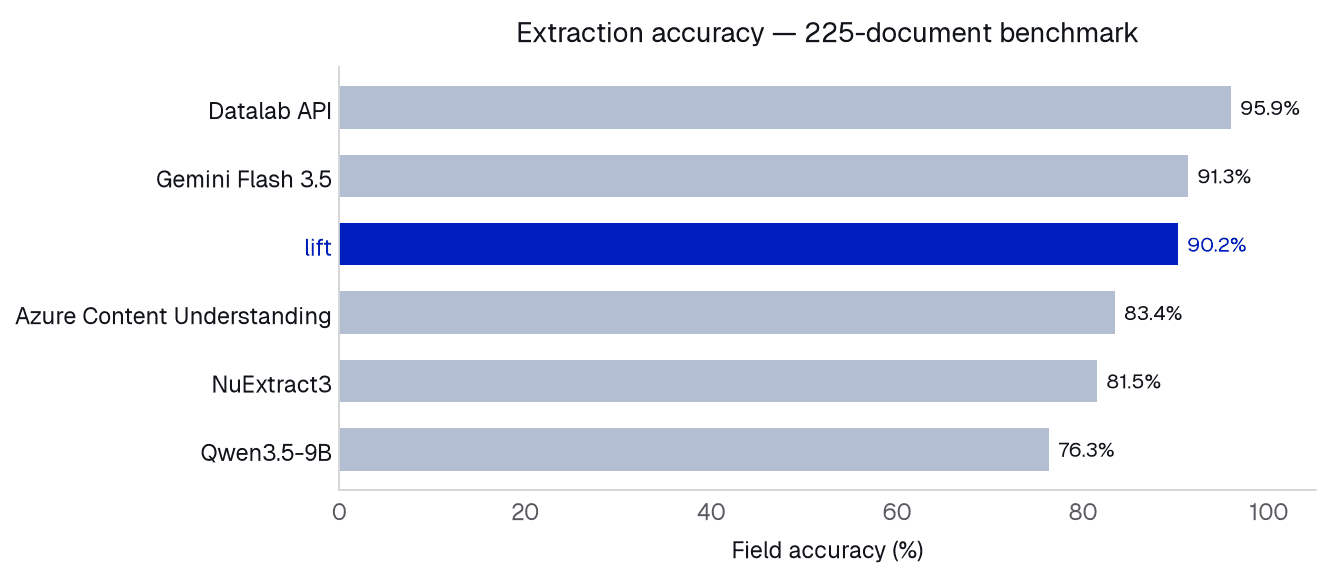
As an initial 1.0 release, LIFT arrives without published parameter counts or benchmark figures in its record, so teams will want to validate it against their own document sets before committing. Still, the arrival of a purpose-built, openly available extraction VLM is a useful addition for anyone tired of brittle, hand-rolled parsing stacks. The model is available now via its Hugging Face repository.
Sources
- Visit
datalab-to/lift
Hugging Face
More in Vision-Language

Agnes-3.0-Flash arrives as a multimodal reasoning model
The new release pairs vision-language understanding with a hybrid-attention design aimed at long-context reasoning.
SenseTime's SenseNova-U1.5 Unifies Vision Tasks
An 8B model drops the usual encoder and VAE in favor of a single native architecture spanning understanding, reasoning, and image generation.
LLaDA-UI Brings Diffusion Decoding to GUI Agents
inclusionAI's 16.7B MoE vision-language model uses block-wise diffusion to drive graphical interface tasks.
0 comments
No comments yet. Be the first to weigh in.