Kling Releases UniVideo for Generation and Understanding
The new open-source model combines both video generation and comprehension, a rare dual capability built on the Qwen2.5 vision-language foundation.
The Kling team has released UniVideo, a new open-source model designed to both generate and understand video content. Unlike many models that focus solely on text-to-video synthesis, UniVideo operates as a unified system, capable of interpreting the contents of a video as well as creating new ones from text prompts.
At its core, UniVideo is built upon Qwen2.5-VL-7B, a powerful large vision-language model. This foundation provides a strong base for processing and relating visual and textual information, allowing a single model architecture to handle tasks that often require separate, specialized systems. This unified approach can lead to more efficient and coherent video processing.
Why It Matters
While the open-source community has made significant strides in video generation, models that also possess deep comprehension abilities are less common. UniVideo helps bridge this gap by providing a single, powerful tool for more complex video-related AI tasks. By combining generation with understanding, it enables new possibilities for content analysis, automated description, and creative workflows within a single framework.
The model is released under a permissive Apache 2.0 license, encouraging broad adoption and experimentation. Researchers and developers can access the model and its code on its Hugging Face repository to explore its dual capabilities.
Sources
- Visit
KlingTeam/UniVideo
Hugging Face
More in Any-to-Any
StepFun's StepAudio 3 Realtime targets live voice AI
The audio-language foundation model builds a listen-converse-think-act loop aimed at natural, low-latency spoken interaction.
SenseTime's SenseNova-U1.5 Unifies Vision Tasks
An 8B model drops the usual encoder and VAE in favor of a single native architecture spanning understanding, reasoning, and image generation.
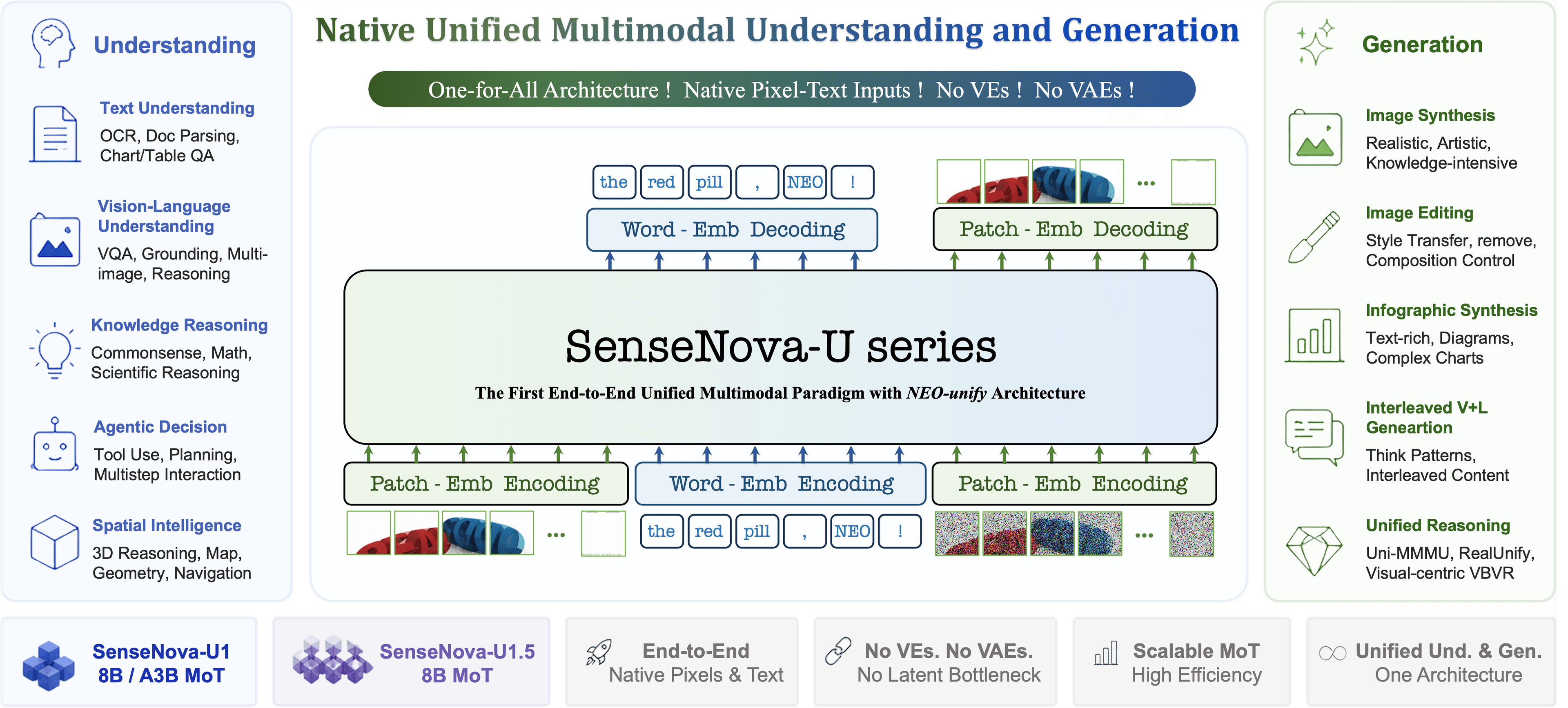
SenseTime Releases SenseNova U1.5 8B Any-to-Any Model
The new 8B multimodal model handles text, images, and image editing within a single native architecture.
0 comments
No comments yet. Be the first to weigh in.