MiniMax Releases M2, an Open-Weight MoE for Agents
The Shanghai-based AI startup has released a new Mixture-of-Experts model focused on complex reasoning, coding, and agentic tasks.
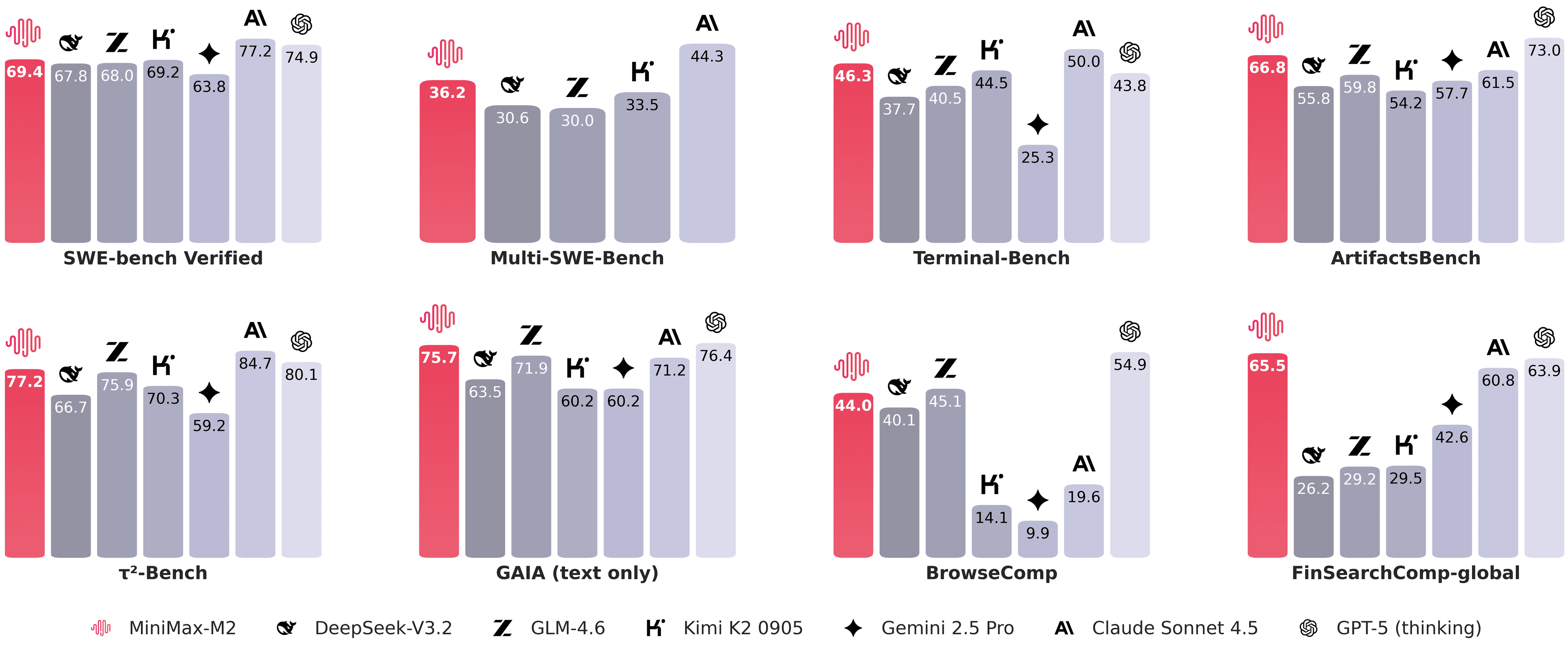
Shanghai-based AI research company MiniMax has released MiniMax-M2, a new large language model with open weights. The model is built on a Mixture-of-Experts (MoE) architecture and is designed for high performance on tasks requiring complex reasoning, coding, and agentic capabilities.
While MiniMax has not disclosed specifics like the model's total parameter count or context window, its MoE design suggests an efficient architecture for handling diverse and complex problems. The company highlights the model's strengths in multi-step reasoning and its potential for powering sophisticated AI agents.
The model weights are available for download on the Hugging Face Hub. However, potential users should note that it is released under a custom license that explicitly forbids commercial use. This positions MiniMax-M2 primarily as a resource for academic and independent researchers to study and build upon.
The release of MiniMax-M2 adds another powerful, specialized MoE model to the open ecosystem. It underscores a growing trend of high-performance models emerging from Chinese AI labs, providing the research community with valuable new artifacts for studying advanced AI architectures and agentic systems, even with commercial-use limitations.
Sources
- Visit
MiniMaxAI/MiniMax-M2
Hugging Face
More in Text / LLM

Agnes-3.0-Flash arrives as a multimodal reasoning model
The new release pairs vision-language understanding with a hybrid-attention design aimed at long-context reasoning.
InternLM's Atria Dawn Preview Targets Agentic Tasks
A new mixture-of-experts model trained on verified tool interactions arrives as an early preview under an MIT license.
ZGCM-1 arrives as a fully open 7B reasoning model
A compact foundation model targets math reasoning and agentic search with tool use, and its makers are releasing it fully open.
0 comments
No comments yet. Be the first to weigh in.