MiniMax Releases M2.5 Mixture-of-Experts Model
The Chinese AI company's first open-weight release uses an efficient FP8 data type but comes with a restrictive, non-commercial license.
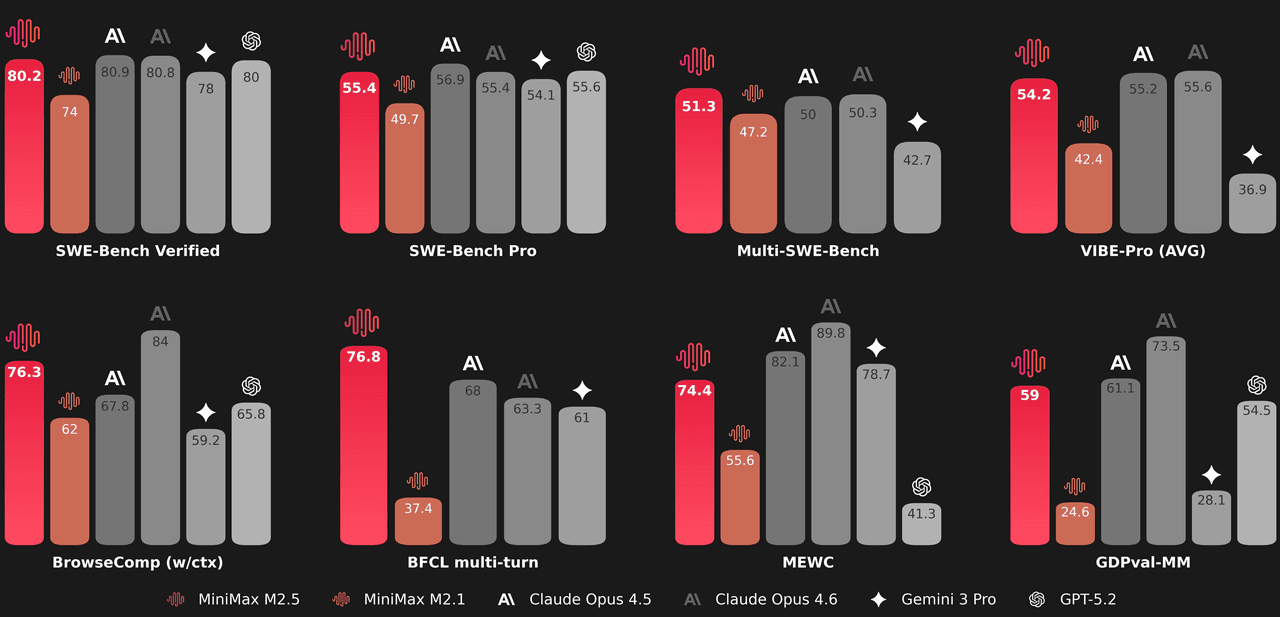
Chinese AI company MiniMax has released MiniMax-M2.5, its first contribution to the open-weight model ecosystem. The new text-generation model employs a Mixture-of-Experts (MoE) architecture, a design known for computational efficiency by activating only specialized parts of the network for any given task.
The most notable technical feature of M2.5 is its use of FP8 weights. By quantizing the model's parameters to an 8-bit floating-point format, MiniMax has significantly reduced the model's memory footprint and potentially increased inference speed compared to models using standard 16-bit formats. This makes the model more accessible to developers and researchers working with consumer-grade hardware.
While the model is publicly available, its utility is limited by its license. MiniMax has released M2.5 under a custom license that prohibits commercial use, positioning it primarily as a resource for academic research and non-commercial experimentation. The full model card and license details are available on its Hugging Face repository.
MiniMax-M2.5's release signals another major AI lab entering the open-weight field, contributing a powerful and efficient architecture. However, its restrictive license highlights a growing trend of "look but don't touch" releases, which allow for research and community evaluation while keeping commercial applications off-limits.
Sources
- Visit
MiniMaxAI/MiniMax-M2.5
Hugging Face
More in Text / LLM

Agnes-3.0-Flash arrives as a multimodal reasoning model
The new release pairs vision-language understanding with a hybrid-attention design aimed at long-context reasoning.

InternLM's Atria Dawn Preview Targets Agentic Tasks
A new mixture-of-experts model trained on verified tool interactions arrives as an early preview under an MIT license.
ZGCM-1 arrives as a fully open 7B reasoning model
A compact foundation model targets math reasoning and agentic search with tool use, and its makers are releasing it fully open.
0 comments
No comments yet. Be the first to weigh in.