Lumina-DiMOO: A Diffusion Model for Any-to-Any AI
This new open-source model uses a diffusion architecture instead of a typical transformer to generate and understand a mix of media types.
A new multimodal model named Lumina-DiMOO has been released, offering a different architectural approach to the increasingly common "any-to-any" AI systems. Published by the research group Alpha-VLLM under a permissive Apache 2.0 license, the model is designed to both understand and generate content across different data types.
A Diffusion-Based Approach
Unlike many popular large language models that rely on a standard transformer architecture, Lumina-DiMOO is built as a diffusion-based LLM. This technique, commonly associated with leading text-to-image generators, creates outputs by progressively refining noise into a coherent result. Applying this to general multimodal tasks represents a notable path for research beyond autoregressive models.
The model's "any-to-any" promise suggests a high degree of flexibility, allowing for various combinations of inputs and outputs. This could enable applications like generating images from detailed text, answering questions about an image, or other complex cross-modal tasks. This versatility makes it a potential foundation for more integrated and context-aware AI.
By exploring an alternative to dominant transformer systems, Lumina-DiMOO provides the open-source community with a new framework for building multimodal AI. The model and its components are available for researchers and developers to explore on Hugging Face.
Sources
- Visit
Alpha-VLLM/Lumina-DiMOO
Hugging Face
More in Any-to-Any
StepFun's StepAudio 3 Realtime targets live voice AI
The audio-language foundation model builds a listen-converse-think-act loop aimed at natural, low-latency spoken interaction.
SenseTime's SenseNova-U1.5 Unifies Vision Tasks
An 8B model drops the usual encoder and VAE in favor of a single native architecture spanning understanding, reasoning, and image generation.
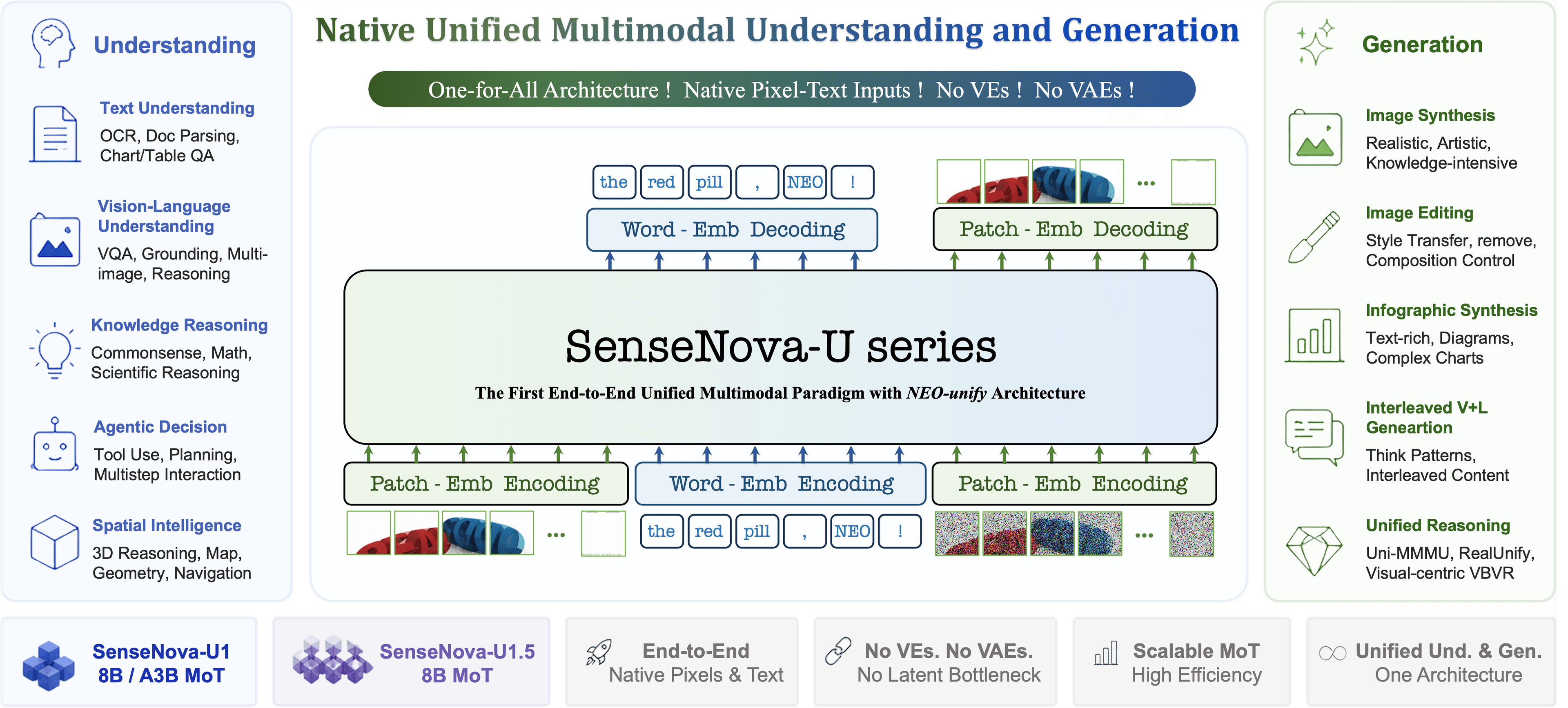
SenseTime Releases SenseNova U1.5 8B Any-to-Any Model
The new 8B multimodal model handles text, images, and image editing within a single native architecture.
0 comments
No comments yet. Be the first to weigh in.