Google DeepMind Releases TabFM for Tabular Data
A new foundation model brings zero-shot, in-context learning to classification and regression on structured tables.
Google DeepMind has published TabFM 1.0.0, a foundation model built for structured, tabular data rather than text or images. The PyTorch release targets two of the most common problems in applied machine learning: classification and regression over rows and columns.
What sets TabFM apart is its approach. Instead of training a fresh model for each dataset, it performs zero-shot, in-context prediction — you supply examples at inference time and the model infers patterns without a dedicated training run. That mirrors the in-context learning that made large language models flexible, applied here to spreadsheets and databases.
Why it matters
Tabular data underpins a huge share of real-world machine learning, from fraud detection to demand forecasting, yet it has largely resisted the foundation-model wave that reshaped language and vision. Practitioners still lean on gradient-boosted trees and bespoke pipelines. A capable general-purpose tabular model could shorten that workflow considerably.
- Handles both classification and regression tasks
- Works in a zero-shot, in-context setting with no per-dataset training
- Distributed as a PyTorch checkpoint on Hugging Face
This is an initial 1.0.0 release, and the record does not specify parameter counts, context limits, or benchmark results. Teams evaluating it will want to check the licensing terms, listed as "other," against their intended use before deploying it in production settings.
Sources
- Visit
google/tabfm-1.0.0-pytorch
Hugging Face
More in Any-to-Any
StepFun's StepAudio 3 Realtime targets live voice AI
The audio-language foundation model builds a listen-converse-think-act loop aimed at natural, low-latency spoken interaction.
SenseTime's SenseNova-U1.5 Unifies Vision Tasks
An 8B model drops the usual encoder and VAE in favor of a single native architecture spanning understanding, reasoning, and image generation.
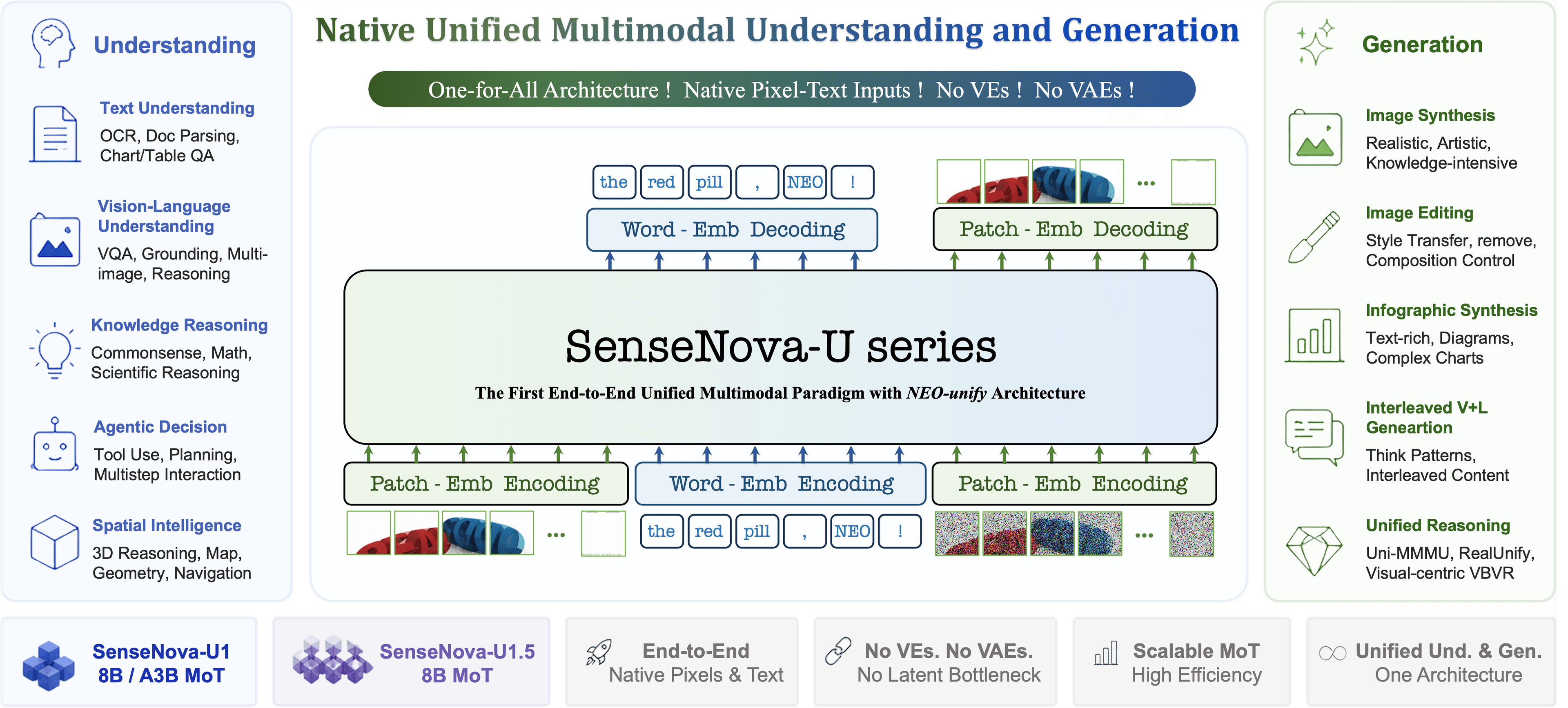
SenseTime Releases SenseNova U1.5 8B Any-to-Any Model
The new 8B multimodal model handles text, images, and image editing within a single native architecture.
0 comments
No comments yet. Be the first to weigh in.