Moondream 3 Arrives in Preview Release
The next generation of the efficient, open-source vision-language model is now available for early testing and feedback.
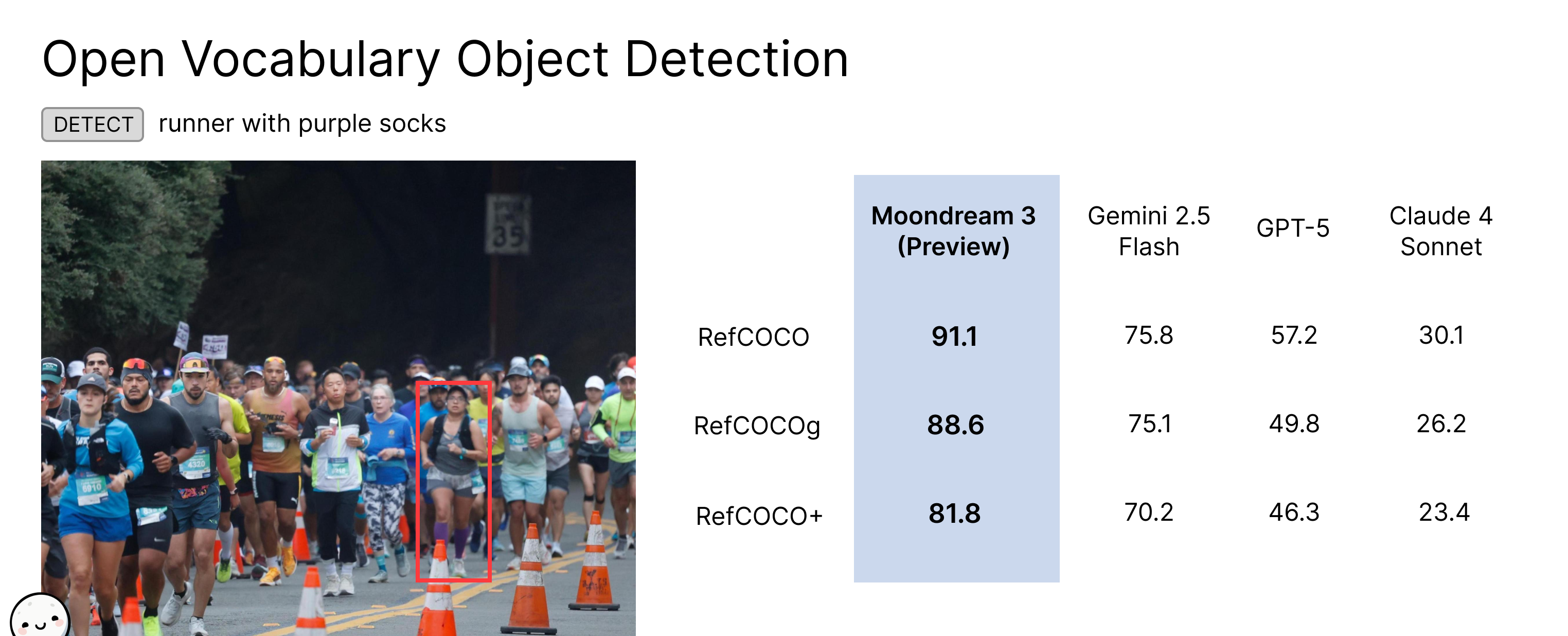
A preview version of Moondream 3, the next iteration of the compact and efficient vision-language model, has been released. Continuing the series' focus on performance in a small footprint, this new model is designed for a variety of image understanding tasks where resource constraints are a key consideration.
A New Architecture
Moondream 3 represents a significant architectural update. The model, which has around 4 billion parameters, is built on two powerful open components: a SigLIP vision encoder for image processing and Microsoft's recently released Phi-3-mini for its language understanding and generation capabilities. According to the release notes, the model was trained from scratch on a new dataset.
The project's goal is to provide a capable but lightweight alternative to the massive vision models released by major labs. By combining best-in-class open components, Moondream 3 aims to deliver strong performance without requiring extensive computational resources, making it suitable for on-device or edge applications.
This release is explicitly a preview intended to gather community feedback for future improvements. Developers can explore the model's capabilities on its Hugging Face repository. It is available for use under a custom 'Moondream license,' which users should review before implementation.
Sources
- Visit
moondream/moondream3-preview
Hugging Face
More in Vision-Language
Agnes-3.0-Flash arrives as a multimodal reasoning model
The new release pairs vision-language understanding with a hybrid-attention design aimed at long-context reasoning.
SenseTime's SenseNova-U1.5 Unifies Vision Tasks
An 8B model drops the usual encoder and VAE in favor of a single native architecture spanning understanding, reasoning, and image generation.
LLaDA-UI Brings Diffusion Decoding to GUI Agents
inclusionAI's 16.7B MoE vision-language model uses block-wise diffusion to drive graphical interface tasks.
0 comments
No comments yet. Be the first to weigh in.