New VLM `dots.ocr` Takes on Complex Documents
The new 3B-parameter model from rednote-hilab uses a vision-language approach to parse tables, layouts, and even mathematical formulas.
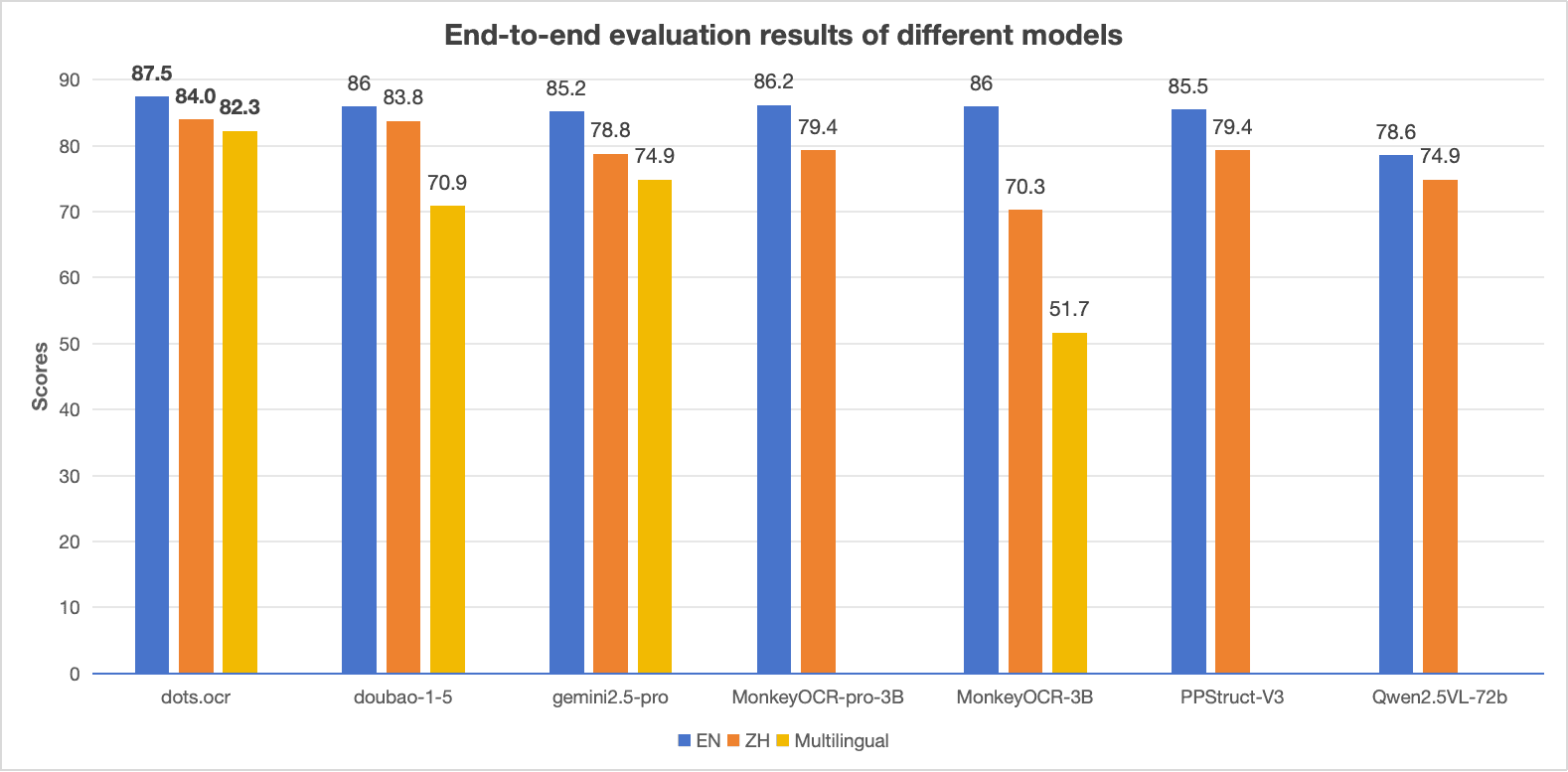
Researchers at rednote-hilab have released dots.ocr, a new open-source model designed for sophisticated document understanding. At 3 billion parameters, this vision-language model (VLM) moves beyond simple text extraction to interpret the complex structure of a page.
Built upon Microsoft's powerful Florence-2 vision foundation model, dots.ocr applies a multi-modal approach to Optical Character Recognition (OCR). Instead of merely identifying characters in sequence, it comprehends the spatial relationships between elements, allowing it to make sense of a document's overall layout.
Advanced Document Parsing
The model's capabilities make it particularly well-suited for digitizing challenging content. It excels at:
- Layout Analysis: Identifying columns, headers, and figures.
- Table Extraction: Accurately parsing rows and columns from structured tables.
- Formula Recognition: Transcribing complex mathematical and scientific notation, a common failure point for traditional OCR systems.
The release of dots.ocr provides a strong, openly-licensed alternative for developers building document intelligence applications. By handling nuanced formats that often require manual intervention, it opens new possibilities for automating data extraction from scientific papers, financial reports, and technical manuals. The model and usage examples are available on its Hugging Face repository.
Sources
- Visit
rednote-hilab/dots.ocr
Hugging Face
More in Vision-Language

Agnes-3.0-Flash arrives as a multimodal reasoning model
The new release pairs vision-language understanding with a hybrid-attention design aimed at long-context reasoning.
SenseTime's SenseNova-U1.5 Unifies Vision Tasks
An 8B model drops the usual encoder and VAE in favor of a single native architecture spanning understanding, reasoning, and image generation.
LLaDA-UI Brings Diffusion Decoding to GUI Agents
inclusionAI's 16.7B MoE vision-language model uses block-wise diffusion to drive graphical interface tasks.
0 comments
No comments yet. Be the first to weigh in.