Microsoft Releases VibeVoice for Real-Time AI Speech
The new 500-million-parameter model is designed for generating natural, long-form speech with very low latency for interactive applications.
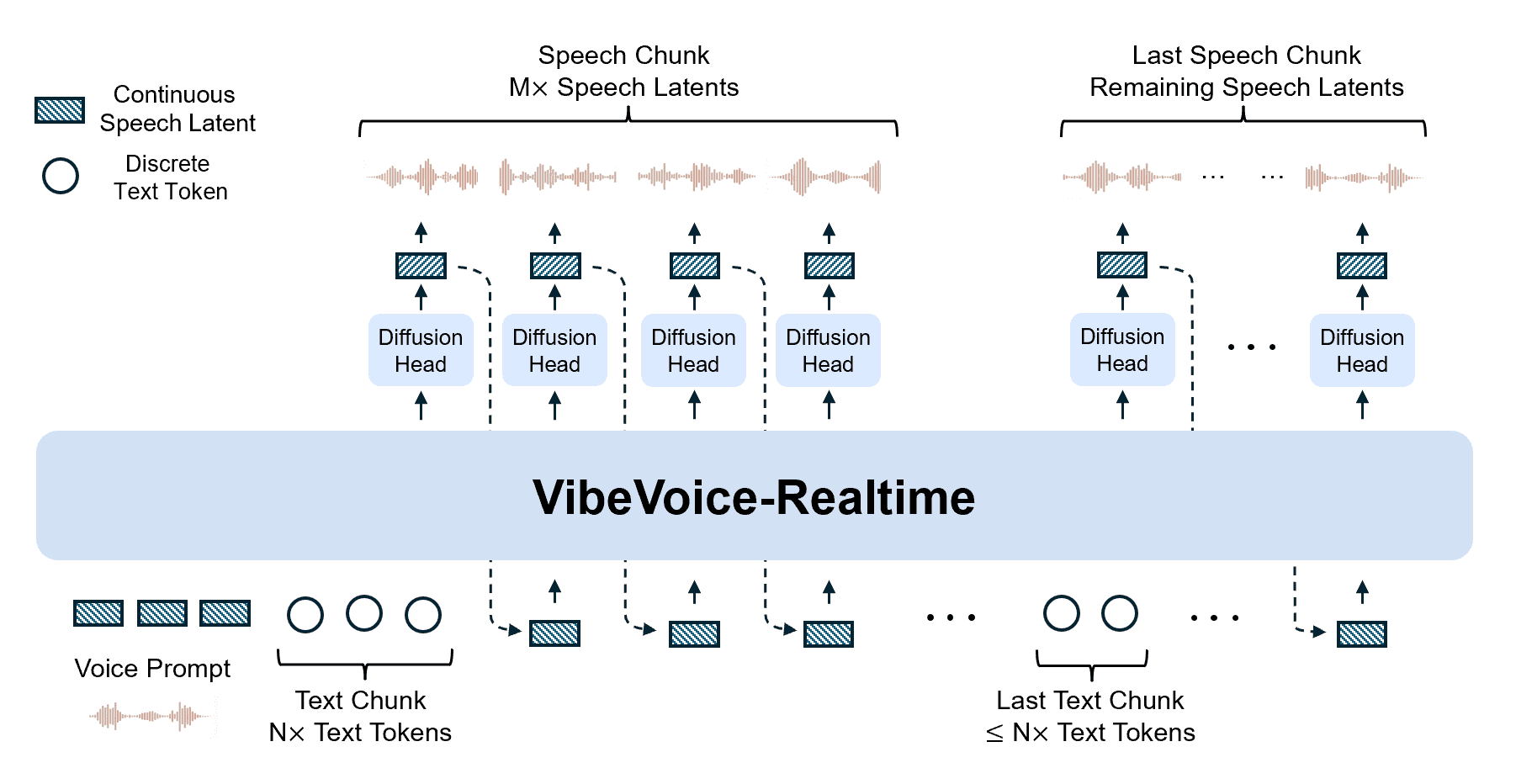
Microsoft has released VibeVoice-Realtime-0.5B, a new open-source model focused on generating high-quality speech with minimal delay. As a streaming text-to-speech (TTS) system, it's engineered to begin producing audio almost instantly, making it suitable for interactive applications where responsiveness is critical.
The model addresses a key challenge in generative audio: latency. While many TTS models produce natural-sounding speech, they often require the entire text input before synthesis can begin. VibeVoice's streaming architecture is built for use cases like real-time conversational agents, live content narration, and accessible tools where a natural, uninterrupted flow is essential.
A Compact and Capable Architecture
VibeVoice is a compact model, containing just 500 million parameters. According to its release page on Hugging Face, it is built upon the Qwen2.5-0.5B language model from Alibaba. This approach of fine-tuning a capable, general-purpose foundation model for a specific task like TTS highlights a common and efficient strategy in AI development.
Key features of the model include:
- Real-time streaming: Enables low-latency audio generation.
- Long-form speech: Capable of handling extended text inputs without degradation.
- Efficient size: The 0.5-billion-parameter architecture is suitable for a wide range of hardware.
Developers and researchers can access VibeVoice-Realtime-0.5B on Hugging Face. However, its use is restricted by a custom license that permits research and non-commercial applications only.
Sources
- Visit
microsoft/VibeVoice-Realtime-0.5B
Hugging Face
More in Text → Speech
StepFun's StepAudio 3 Realtime targets live voice AI
The audio-language foundation model builds a listen-converse-think-act loop aimed at natural, low-latency spoken interaction.
StepFun's StepAudio 3 Gen Unifies TTS and Music
A single discrete autoregressive model handles speech, voice design, sound effects, and music generation.

Breeze-TTS-2 Brings Open Voice Cloning to English
BreezeBlue's second-generation text-to-speech model pairs voice cloning with controllable direction, all under an open release on Hugging Face.
0 comments
No comments yet. Be the first to weigh in.