Baidu Releases Open VLM for Advanced Document OCR
The new PaddleOCR-VL model is built to parse not just text, but also the tables, formulas, and page layouts found in complex documents.
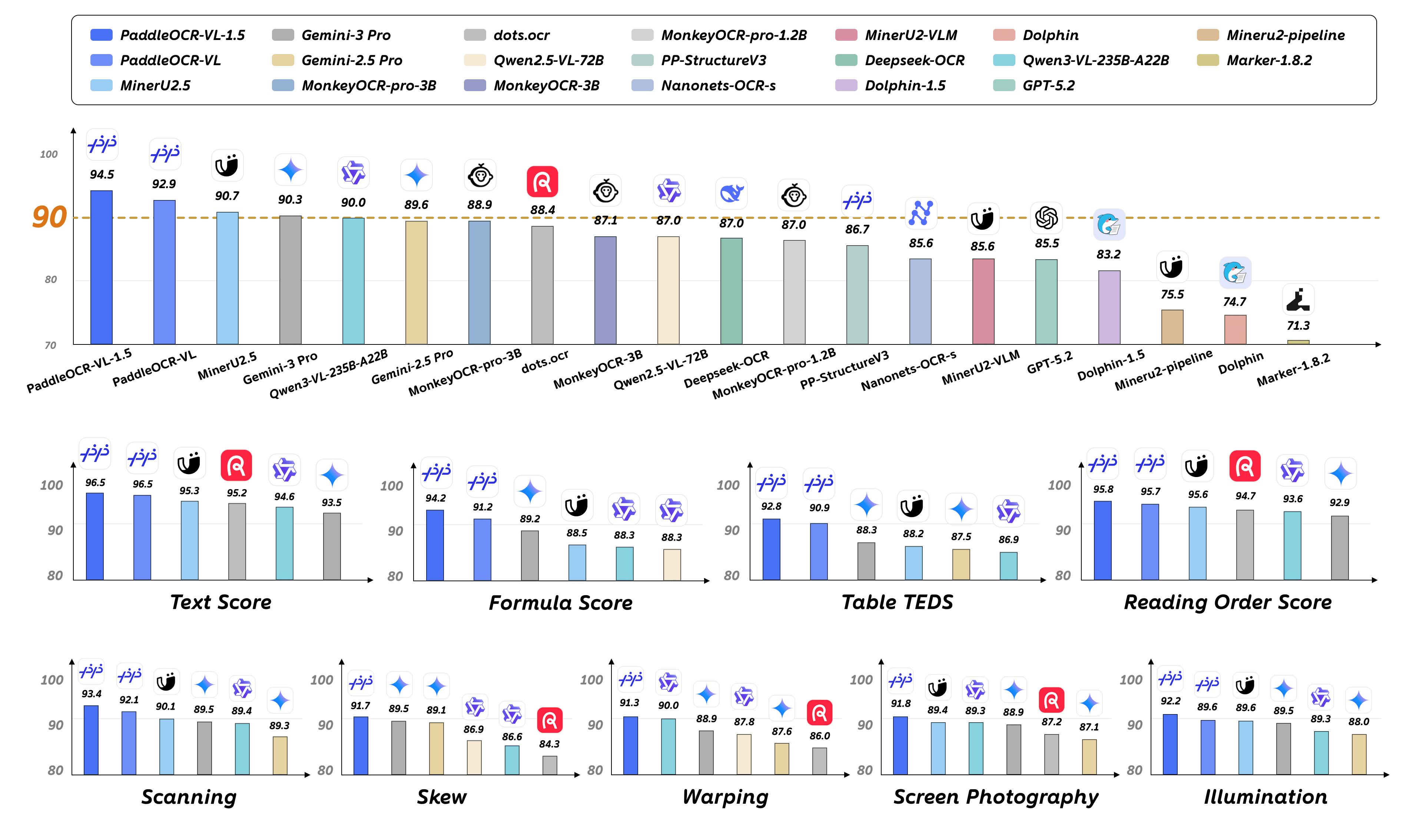
Baidu has released PaddleOCR-VL-1.5, a new open-source vision-language model specialized in advanced document analysis. Released under a permissive Apache 2.0 license, the model aims to move beyond simple text extraction to understand the full structure and content of complex documents.
Unlike traditional OCR tools that focus solely on converting characters, PaddleOCR-VL is designed to handle a wider range of document intelligence tasks. According to its release notes, its key capabilities include:
- Full-page layout parsing
- Table structure recognition and extraction
- Mathematical formula detection
- Chart and graph analysis
This makes the model particularly suited for applications in academic research, finance, and enterprise document management, where information is often presented in structured, non-prose formats.
The model is based on Baidu's ERNIE 4.5 foundation, extending its multimodal capabilities specifically for the document OCR domain. By open-sourcing this specialized tool, Baidu provides developers with a powerful component for building applications that can digitize and interpret intricate information from images and scans. The model is available now on Hugging Face for community use and development.
Sources
- Visit
PaddlePaddle/PaddleOCR-VL-1.5
Hugging Face
More in Vision-Language

Agnes-3.0-Flash arrives as a multimodal reasoning model
The new release pairs vision-language understanding with a hybrid-attention design aimed at long-context reasoning.
SenseTime's SenseNova-U1.5 Unifies Vision Tasks
An 8B model drops the usual encoder and VAE in favor of a single native architecture spanning understanding, reasoning, and image generation.
LLaDA-UI Brings Diffusion Decoding to GUI Agents
inclusionAI's 16.7B MoE vision-language model uses block-wise diffusion to drive graphical interface tasks.
0 comments
No comments yet. Be the first to weigh in.