OUI-1: A Gemma-based diffusion model for generative UI
Thesys releases an experimental diffusion language model aimed at turning prompts into user interfaces, built atop Google's Gemma.
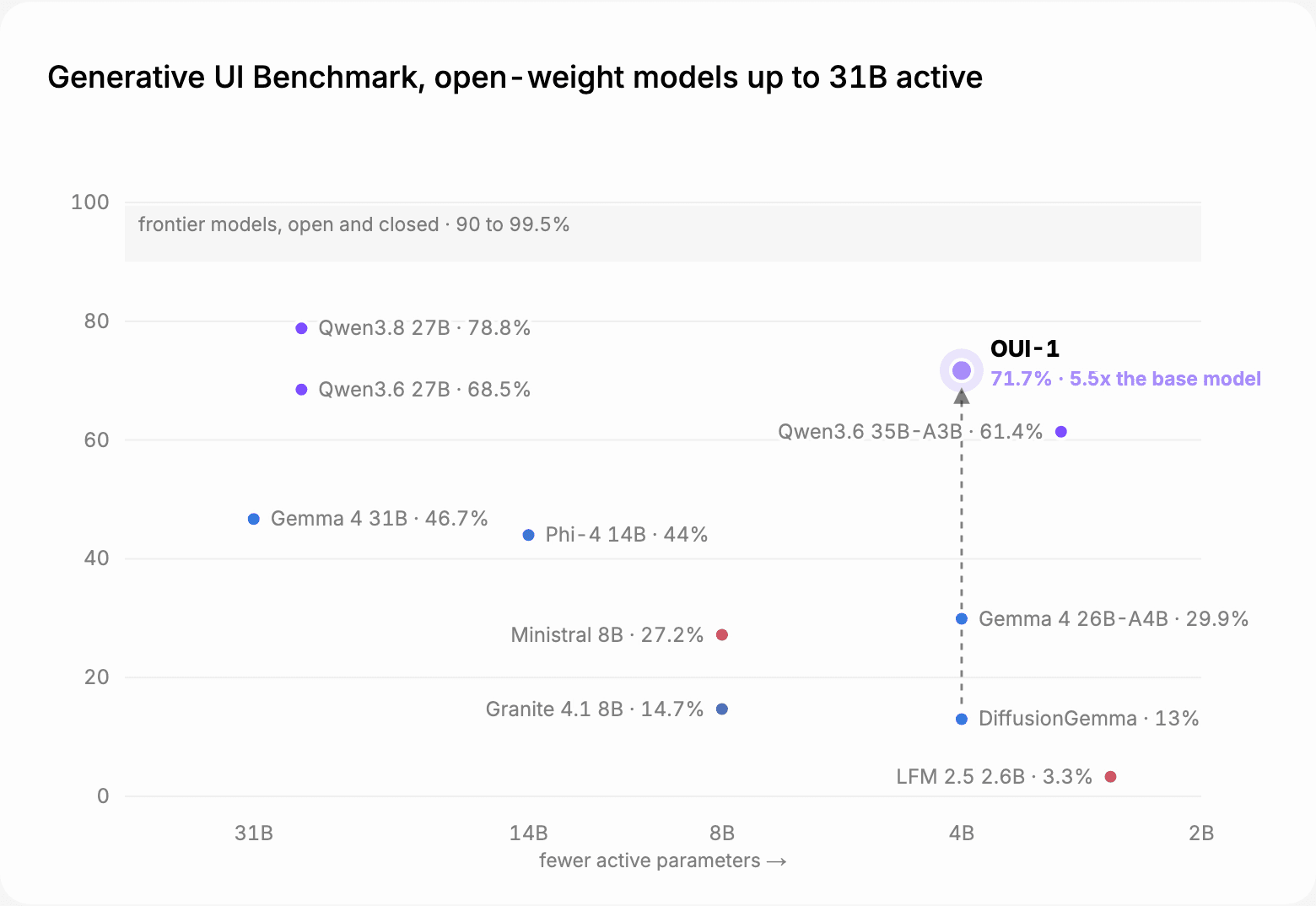
A new model called OUI-1 has appeared on Hugging Face, positioned as a diffusion language model for generative user-interface tasks. Published by the thesysdev account and built on Google's Gemma foundation, it is released under the Gemma license as an initial, minor release (model card).
The premise is what makes it notable. Most text models generate tokens left to right; a diffusion approach instead refines an entire output in parallel across denoising steps. Pairing that technique with a UI-generation goal suggests an interest in producing structured layouts and code where the whole design is considered at once rather than assembled sequentially.
What we know
- Base: Gemma, Google's open model family
- Type: diffusion language model, text and code
- Purpose: generative UI tasks
- License: Gemma
Several key details are not yet published, including parameter count, context length, and benchmark results. Without those figures it is hard to judge how OUI-1 compares to conventional code and UI generators, and buyers should treat it as an early experiment rather than a finished tool.
Why it matters: generative UI is a fast-growing niche, and applying diffusion to it is an unusual bet. If the approach holds up, parallel generation could offer a different speed-and-coherence tradeoff for building interfaces from natural language. For now, OUI-1 is worth watching as a signal of where open, Gemma-derived tooling is heading.
Sources
- Visit
thesysdev/OUI-1
Hugging Face
More in Text / LLM
Agnes-3.0-Flash arrives as a multimodal reasoning model
The new release pairs vision-language understanding with a hybrid-attention design aimed at long-context reasoning.
Tencent's T1 Targets Long-Horizon Terminal Work
A 122B mixture-of-experts model trained with reinforcement learning claims state-of-the-art results on Terminal-Bench.
Nex-N2.5-Pro arrives as an Apache-2.0 MoE vision model
A permissively licensed multimodal mixture-of-experts model built on a Qwen3-style MoE backbone.
0 comments
No comments yet. Be the first to weigh in.