MiniMax Releases M2.7, an MoE Model with FP8 Weights
The new conversational language model from the Chinese AI company uses a Mixture-of-Experts architecture and 8-bit weights, but is released under a restrictive custom license.
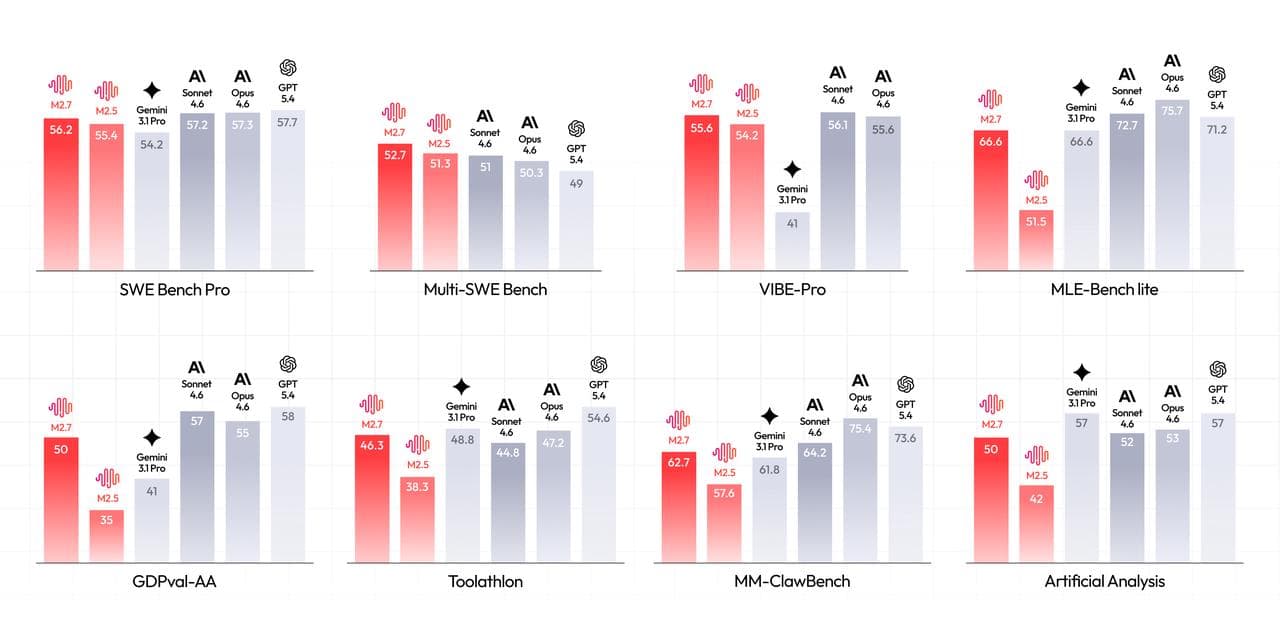
AI research company MiniMax has publicly released MiniMax-M2.7, a new conversational language model. The release provides another advanced model from one of China's prominent AI labs, designed for general-purpose text generation and reasoning tasks.
Efficient Architecture
The model stands out for its technical design. It employs a Mixture-of-Experts (MoE) architecture, a technique known for improving model performance without a proportional increase in computational cost during inference. Additionally, MiniMax-M2.7 is distributed with FP8 (8-bit floating-point) weights. This level of quantization significantly reduces the model's memory and storage footprint, potentially enabling faster performance on a wider range of hardware.
While the weights are publicly available on the Hugging Face Hub, the model is governed by a custom license. This license explicitly restricts commercial use, placing it in the category of 'open-weight' releases intended for research and non-commercial experimentation. This continues a trend of models being made available to the public with specific limitations, distinct from traditional permissive open-source software.
Sources
- Visit
MiniMaxAI/MiniMax-M2.7
Hugging Face
More in Text / LLM
Agnes-3.0-Flash arrives as a multimodal reasoning model
The new release pairs vision-language understanding with a hybrid-attention design aimed at long-context reasoning.

InternLM's Atria Dawn Preview Targets Agentic Tasks
A new mixture-of-experts model trained on verified tool interactions arrives as an early preview under an MIT license.
ZGCM-1 arrives as a fully open 7B reasoning model
A compact foundation model targets math reasoning and agentic search with tool use, and its makers are releasing it fully open.
0 comments
No comments yet. Be the first to weigh in.